
Affiliate disclosure: This article may contain affiliate links. If you purchase through our links, Only For U Deals may earn a commission at no additional cost to you.
How long does ProDentim take to work? There is currently no clinically established timeline that applies to the complete ProDentim formula.
Some people may notice a different taste or a temporary feeling of fresher breath soon after taking a tablet. However, an immediate sensation does not demonstrate that the probiotic microorganisms have changed the oral microbiome or produced a measurable health benefit.
Studies involving other oral probiotic products have evaluated outcomes over periods ranging from approximately two weeks to three months or longer. These studies use different strains, doses, delivery methods and participant groups, so their timelines cannot be transferred directly to ProDentim.
During our latest search, updated on July 29, 2026, we could not identify a published peer-reviewed clinical trial that established when the finished ProDentim formula begins working.
The most responsible answer is therefore:
Some changes may be noticed within a few weeks, but there is no evidence-based number of days in which ProDentim should produce results.
Quick answer: When does ProDentim start working?
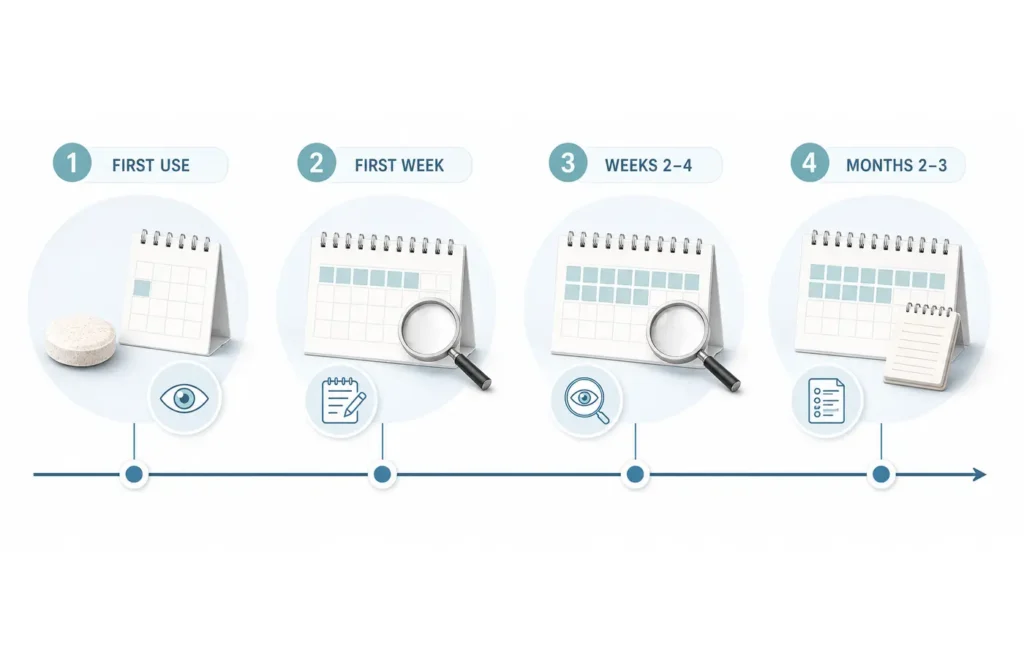
A realistic ProDentim results timeline depends on what someone means by “working.”
| Time period | What someone might evaluate | What it cannot prove |
|---|---|---|
| First use | Flavor, ease of use, tablet dissolution and temporary breath freshness | A probiotic effect or improvement in dental health |
| First week | Tolerance and whether the product fits the daily routine | Reliable changes in gums, plaque, cavities or the oral microbiome |
| Two to four weeks | Possible changes in perceived breath freshness or gum comfort | That ProDentim treats the cause of bad breath or gum disease |
| One to three months | Whether a consistent routine appears to provide a personally meaningful benefit | That the product has repaired teeth, reversed disease or produced permanent microbial changes |
| Beyond three months | Whether continuing is reasonable based on benefit, cost and professional advice | That longer use will eventually work if no benefit has been identified |
These are evaluation periods, not guaranteed ProDentim milestones.
Research involving selected oral probiotics has reported short-term changes within two to four weeks. Other studies have measured periodontal outcomes after eight, twelve or more weeks. However, those findings involve specific research products rather than the complete ProDentim formula.
Does ProDentim have an official results timeline?
The archived ProDentim label in the NIH Dietary Supplement Label Database recommends taking one soft tablet, ideally after brushing or using mouthwash, and allowing it to dissolve completely in the mouth.
The label provides directions for use, but it does not establish a clinically proven timeline for results.
A suggested serving tells consumers how the manufacturer intends the product to be used. It does not demonstrate:
- How many days are necessary to produce a benefit.
- Which users are likely to respond.
- How large the average effect may be.
- Whether a benefit will continue after use stops.
- Whether the complete formula performs better than a placebo.
The database records information from the supplement label. Inclusion does not mean that NIH tested, approved or independently verified the product.
Our guide explaining how to take ProDentim examines the archived directions and common usage mistakes in more detail.
Why is there no exact ProDentim timeline?
A reliable timeline would require a clinical trial of the finished commercial formula.
Researchers would need to:
- Identify the exact ProDentim formulation.
- Confirm the included probiotic strains and viable microorganism counts.
- Randomly assign participants to ProDentim or a placebo.
- Keep other oral care factors reasonably consistent.
- Measure specific outcomes at predetermined intervals.
- Report how many participants improved and by how much.
- Monitor whether any changes continued after supplementation ended.
Measurements could be collected at baseline and after two, four, eight and twelve weeks, for example.
Without this type of product-specific research, statements that ProDentim works within a particular number of days are generally based on marketing, testimonials or extrapolation from studies of other probiotics.
Our evidence review explains in greater detail whether ProDentim works and what has actually been studied.
What does “working” mean for an oral probiotic?
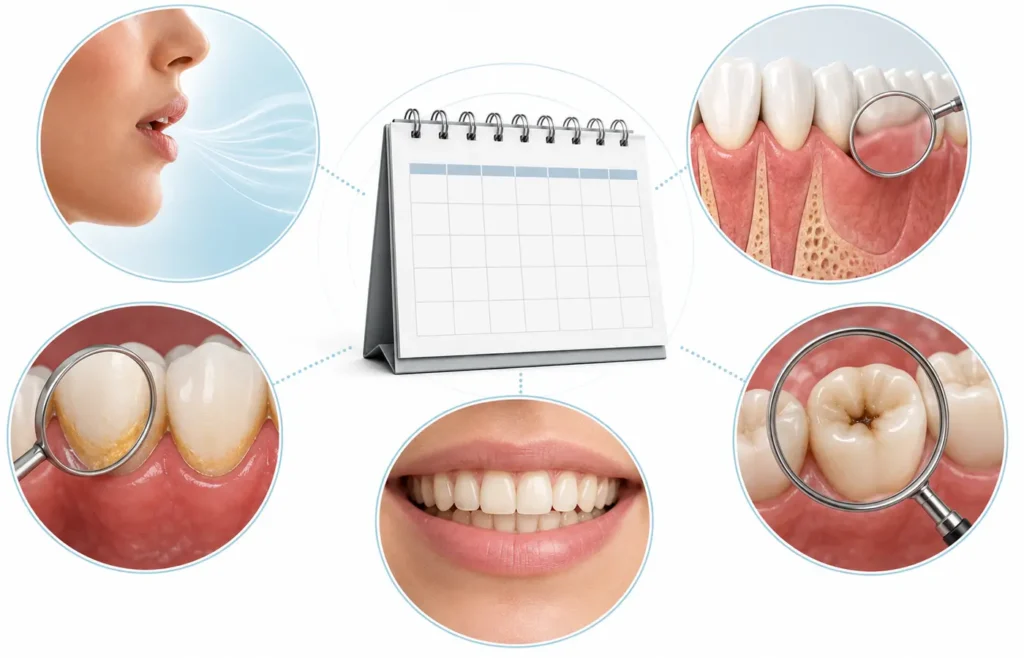
A timeline is only useful when the expected outcome is clearly defined.
Someone interested in breath freshness is measuring something different from a person concerned about bleeding gums, cavities, enamel strength or plaque.
Breath freshness
Perceived breath freshness can change quickly because of flavoring, saliva production, hydration, tongue cleaning or recent food and drink.
A person may feel that the mouth is fresher after taking a tablet, but that sensation does not confirm a lasting probiotic effect.
Persistent halitosis can be caused by tongue coating, gum disease, cavities, dry mouth, tobacco use, tonsil stones, medication or medical conditions. Masking the odor temporarily is different from addressing its cause.
Gum comfort
Gum comfort is subjective and may be influenced by changes in brushing pressure, flossing, dental cleaning and oral hygiene consistency.
Objective gum outcomes include:
- Bleeding on probing.
- Gingival inflammation.
- Periodontal pocket depth.
- Clinical attachment level.
- Plaque measurements.
These outcomes are better evaluated by a dental professional.
Plaque
A cleaner feeling does not necessarily mean that less dental plaque is present.
Plaque is a biofilm that must be disrupted through brushing and interdental cleaning. An oral probiotic should not replace mechanical plaque removal.
Cavities
Cavities cannot be meaningfully evaluated over a few days or through a subjective feeling.
Changes in certain bacterial counts are not equivalent to preventing cavities. Caries development is influenced by sugar exposure, fluoride, saliva, dental anatomy, hygiene and individual risk.
There is no reliable evidence that ProDentim repairs an existing cavity.
Tooth strength or whitening
We could not identify direct clinical evidence showing how quickly, or whether, the finished ProDentim formula strengthens enamel or whitens teeth.
A temporary clean or bright appearance should not be interpreted as enamel repair. Changes in lighting, hydration and surface staining can also affect how teeth appear.
What do oral probiotic studies reveal about timing?
Research involving oral probiotics provides context, but it does not create a ProDentim results schedule.
The studies evaluate different:
- Probiotic strains.
- Daily amounts.
- Formulations.
- Treatment periods.
- Oral health conditions.
- Professional treatments.
- Methods of measuring results.
The NIH Office of Dietary Supplements explains that probiotic effects can be strain-specific. It also notes that many commercial probiotic products have not been evaluated in research.
This means the result of one lozenge containing a defined strain cannot automatically be applied to another product that lists only the same general species.
Studies involving bad breath
Some halitosis studies have reported changes over relatively short periods.
A systematic review and meta-analysis of probiotics for halitosis found possible improvements in some measurements during short-term interventions lasting four weeks or less.
The review did not establish that every probiotic works within four weeks. The included studies used different microorganisms and methods of measuring breath.
A separate 30-day study involving Streptococcus salivarius K12 evaluated a specific strain and tablet rather than ProDentim.
More recent reviews continue to describe promising findings while emphasizing limitations involving small samples, heterogeneous protocols and insufficient long-term follow-up. A 2025 systematic review of probiotic monotherapy for oral halitosis found favorable results in several trials but concluded that larger and more standardized studies are still needed.
These findings make two to four weeks a relevant research window for selected halitosis products. They do not prove that ProDentim will improve breath within that period.
Studies involving gum health
Periodontal research often uses longer follow-up periods and evaluates probiotics as additions to professional treatment.
A 2024 randomized placebo-controlled study evaluated one Lactobacillus reuteri lozenge daily for 90 days in 28 people receiving supportive periodontal care.
Measurements were taken at baseline and after four, eight and twelve weeks. Participant responses varied, and bleeding on probing was the only clinical parameter that showed a statistically significant reduction in the overall analysis.
That study illustrates why periodontal results cannot be reduced to a universal statement such as “probiotics work after 30 days.”
It also did not evaluate ProDentim.
A broader 2024 systematic review and network meta-analysis examined probiotics used alongside professional mechanical plaque removal. Some interventions were associated with improvements in periodontal measurements, but the products, protocols and microorganisms varied.
The evidence supports continued research into probiotics as adjuncts. It does not show that waiting several months for ProDentim can replace periodontal treatment.
Studies involving the oral microbiome
Microbial measurements may change before a person notices a meaningful clinical difference.
However, detecting more or fewer microorganisms does not automatically show that:
- Gums have become healthier.
- Cavities have been prevented.
- Teeth have become stronger.
- Bad breath has been permanently resolved.
- The new microbial pattern will remain after supplementation stops.
A laboratory or saliva test can detect a biological change without demonstrating a clinically important benefit.
Research involving cavities
Cavity prevention requires longer observation than perceived breath freshness.
Studies may initially measure salivary bacteria as a surrogate outcome because new cavities take time to develop. A change in bacterial counts is easier to detect, but it does not necessarily result in fewer cavities.
Evidence concerning oral probiotics and caries remains mixed. ProDentim should not replace fluoride toothpaste, dietary risk management or preventive dental care while someone waits for a possible probiotic effect.
A realistic ProDentim results timeline
The following timeline is designed to help evaluate use without presenting invented milestones.
Day 1: Evaluate the product experience
On the first day, someone can reasonably evaluate:
- Flavor.
- Texture.
- How easily the tablet dissolves.
- Whether the directions are practical.
- Any immediate discomfort.
- A temporary sensation of freshness.
It is too early to conclude that the oral microbiome has been meaningfully changed.
Peppermint, increased saliva and the act of allowing a tablet to dissolve can influence how the mouth feels immediately. That experience may be pleasant, but it is not proof that the probiotics have produced a health outcome.
First week: Focus on tolerance and consistency
During the first week, the main questions are whether the product is tolerated and whether it can be used consistently as directed.
Possible observations include:
- Digestive comfort.
- Mouth irritation.
- Changes in taste.
- Ease of remembering the serving.
- Whether the product affects the normal hygiene routine.
One week is generally too short to make a confident judgment about gum health, plaque, cavities or lasting microbial changes.
Dental pain, swelling or bleeding should not be ignored on the assumption that the product needs more time.
Weeks two to four: Look for a specific, modest change
Some oral probiotic studies measure breath-related outcomes after two to four weeks. This makes the period relevant for observing whether there is a consistent change in perceived freshness.
It is still important to distinguish among:
- A brief mint-like sensation after taking the tablet.
- Improved breath throughout the day.
- A change noticed only by the user.
- A change confirmed by another person or objective measurement.
- Resolution of the underlying cause of halitosis.
Gum comfort may also be monitored, but this period does not prove that periodontal disease has improved.
If the only evidence is a vague feeling that the product “might be doing something,” the result remains uncertain.
One to three months: Reassess whether there is a meaningful benefit
Several periodontal studies measure outcomes over eight to twelve weeks. That does not create a requirement to use ProDentim for three months, but it provides a reasonable point for a structured personal reassessment.
Questions to consider include:
- Has the original goal changed?
- Is any improvement consistent rather than occasional?
- Could the change be explained by better brushing or flossing?
- Has a dental professional measured an objective improvement?
- Does the perceived benefit justify the cost?
- Have any symptoms worsened?
- Is the product being used instead of necessary care?
Continuing for longer does not guarantee that a result will eventually appear.
Beyond three months: Do not continue only because results might be delayed
There is no product-specific evidence showing that every non-responder simply needs additional bottles.
Long-term use may be reasonable for someone who tolerates the supplement, identifies a worthwhile benefit and has no relevant medical concern. However, purchasing a three-month or six-month package does not prove that those durations are clinically necessary.
Package size is a commercial option, not an evidence-based treatment period.
If no clear benefit has been identified, the decision to continue should be reconsidered rather than based on the belief that results are guaranteed later.
Can ProDentim work immediately?
ProDentim may create an immediate sensation, but an immediate probiotic health effect has not been established.
The tablet format can influence:
- Saliva production.
- Taste.
- Mouthfeel.
- Perceived freshness.
These changes may occur during or shortly after use.
A genuine clinical outcome involving gum inflammation, periodontal pockets, plaque or cavities requires a different type of measurement and cannot be confirmed from a single serving.
“Feeling something” and “producing a clinically meaningful benefit” are not the same standard.
Can ProDentim work within 30 days?
It is possible that some users will report changes within 30 days. However, there is no published product-level trial establishing a ProDentim 30-day success rate.
Thirty days is long enough to evaluate:
- Whether the routine is sustainable.
- Whether the product is well tolerated.
- Whether breath freshness appears consistently different.
- Whether a clearly defined subjective goal has improved.
Thirty days is not enough to conclude that ProDentim has:
- Prevented future cavities.
- Repaired an existing cavity.
- Regenerated gum tissue.
- Strengthened enamel.
- Produced permanent changes in the oral microbiome.
- Eliminated the need for professional dental care.
A lack of noticeable results after one bottle does not scientifically prove that the product could never help. It also does not create an obligation to keep purchasing it.
Does ProDentim need three to six months?
There is no peer-reviewed clinical evidence showing that every ProDentim user needs three to six months.
Longer supplement packages are frequently presented as a way to maintain a consistent supply or reduce the cost per bottle. They should not be interpreted as proof of a medically required treatment duration.
A three-month period is used in some oral probiotic studies, but those trials involve their own strains, doses, products and outcomes.
Extending the duration cannot compensate for:
- An unsuitable probiotic strain.
- Low microorganism viability.
- An untreated dental problem.
- Unrealistic expectations.
- Inconsistent use.
- A symptom caused by something the supplement does not address.
Before committing to longer use, consumers should review the current label, ingredients, total cost, refund terms and personal health circumstances.
Why might one person notice results sooner than another?
Individual ProDentim results can vary for several reasons.
Different goals
Breath freshness can be perceived sooner than a change in professionally measured gum health. Cavity prevention cannot be evaluated on the same timeline as taste or mouthfeel.
Existing dental problems
A person with generally healthy teeth and gums is different from someone with active cavities, periodontitis, severe dry mouth or an infection.
A supplement is unlikely to resolve a structural or untreated dental problem simply because it is used for longer.
Oral hygiene
Brushing technique, interdental cleaning and tongue cleaning can affect many of the same outcomes attributed to an oral probiotic.
Someone who improves the entire routine when beginning ProDentim may experience changes that cannot be assigned to the supplement alone.
Diet and lifestyle
Sugar exposure, hydration, smoking, alcohol and food choices influence plaque, saliva, breath and the oral environment.
Saliva
Saliva helps neutralize acids and move substances through the mouth. Dry mouth caused by medication, dehydration or a health condition may substantially influence the experience.
Probiotic strain
Benefits associated with probiotics can be strain-specific.
The ProDentim ingredients guide explains that the archived label does not provide complete strain designations for every listed microorganism.
This limits how confidently published research can be matched to the formula.
Microorganism viability
Probiotics must remain viable during manufacturing, storage and the product’s shelf life.
A laboratory analysis of 21 commercial oral probiotic products found substantial variation in viable microorganism counts and strain characterization.
The study did not test ProDentim specifically. It demonstrates why the number printed on a label does not by itself establish performance.
Expectations and placebo effects
A positive expectation can affect how someone perceives breath, comfort and other subjective experiences.
This does not mean that every reported improvement is imaginary. It means that subjective results are more difficult to separate from expectation without a placebo-controlled trial.
How can you track ProDentim results more objectively?
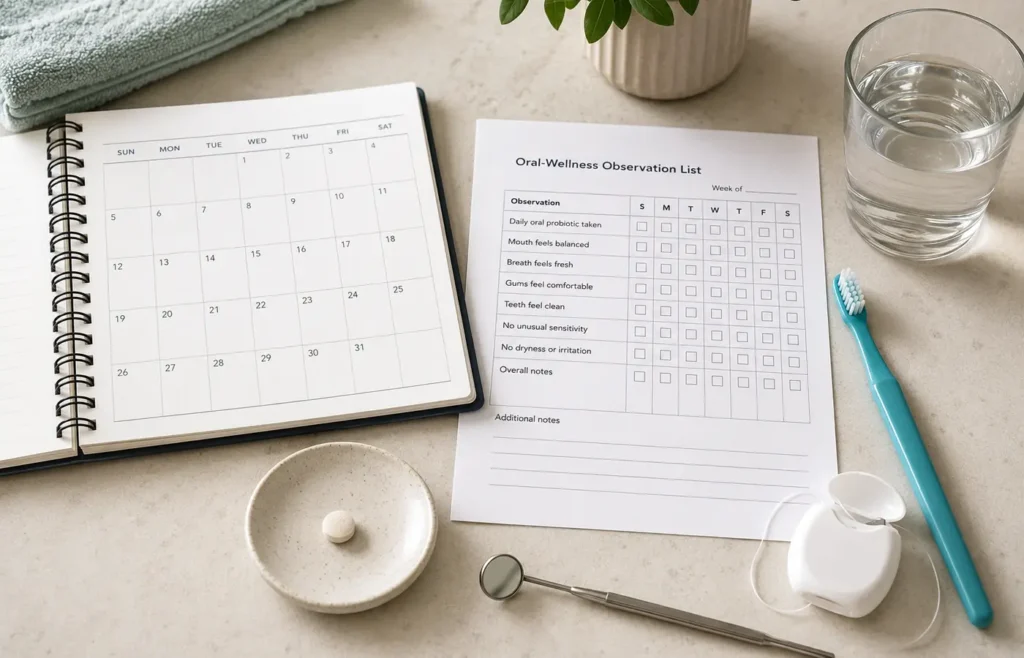
A simple tracking plan is more useful than trying to remember whether the mouth feels generally different.
Choose one primary goal
Examples include:
- Perceived breath freshness.
- Gum comfort.
- Oral dryness.
- Product tolerance.
- Ease of maintaining the routine.
Avoid combining every possible outcome into one vague goal such as “better oral health.”
Record a baseline
Before starting, record the condition for several days.
For breath freshness, use the same observation times each day. For gum concerns, a dental examination provides a more reliable baseline than photographs alone.
Keep the rest of the routine consistent
Changing toothpaste, brushing frequency, tongue cleaning, flossing, diet and mouthwash at the same time makes it difficult to identify what produced the result.
Do not keep an ineffective hygiene routine simply for the sake of an experiment. Standard dental care remains the priority.
Use regular checkpoints
A practical schedule could be:
- Day 1 for product experience.
- End of week 1 for tolerance.
- End of week 4 for a defined subjective goal.
- Between weeks 8 and 12 for a broader cost-benefit reassessment.
This schedule is for personal organization. It is not a clinically validated ProDentim protocol.
Look for consistency
A result that appears only immediately after the tablet may be related to flavor or saliva.
A more meaningful subjective observation would be a repeated difference under similar conditions over several days.
Use professional measurements when appropriate
A dentist can evaluate:
- Gum bleeding.
- Periodontal pockets.
- Plaque.
- Cavities.
- Recession.
- Tooth mobility.
- Dry mouth.
- Causes of persistent halitosis.
A supplement should not be credited with repairing a condition that has not been professionally diagnosed or measured.
What if ProDentim does not work after 30 days?
First, return to the original goal.
If the goal was fresher breath, determine whether there has been a consistent difference beyond the temporary effect of taking the tablet.
If the goal involved bleeding gums, cavities, plaque, tooth pain or gum recession, the appropriate next step is not simply waiting for another bottle. Those concerns require established oral care and, when persistent, professional evaluation.
After 30 days, reasonable questions include:
- Was the product used according to the current label?
- Was the goal realistic?
- Was the outcome measured consistently?
- Were other parts of the routine changed?
- Could an untreated dental or medical problem explain the symptom?
- Is there enough perceived benefit to justify continuing?
- Is the purchase still within the current refund period?
There is no rule requiring everyone to continue until three or six months.
Do oral probiotic results last after stopping?
There is no direct evidence showing how long ProDentim results last after supplementation ends.
Some probiotic microorganisms may be detected temporarily during or after use, while others do not establish lasting colonization. Persistence depends on the strain, delivery method, existing microbiome and individual environment.
A study examining oral colonization after probiotic administration noted that the microorganisms could colonize during use but gradually disappeared after intake ended.
That study involved a different probiotic preparation and should not be treated as evidence about ProDentim.
Even when a study reports that microbial changes persist for a period, that does not prove a permanent health benefit.
Should results become worse before they improve?
There is no reliable evidence that worsening dental symptoms represent a necessary “detox,” “die-off” reaction or proof that ProDentim has started working.
Do not interpret the following as normal evidence of progress:
- Increasing tooth pain.
- Gum swelling.
- Pus.
- Persistent bleeding.
- New sensitivity.
- Loose teeth.
- Mouth sores.
- Facial swelling.
- Difficulty swallowing.
- Signs of an allergic reaction.
Probiotics can sometimes cause minor digestive symptoms such as gas, particularly when a person begins using them. Persistent, severe or concerning reactions warrant stopping the supplement and seeking appropriate guidance.
Our guide to possible ProDentim side effects covers safety considerations in greater detail.
Can taking more ProDentim make it work faster?
Taking more than the suggested serving has not been shown to accelerate results.
A larger amount does not automatically provide a greater probiotic benefit. The NIH notes that products with higher CFU counts are not necessarily more effective than products with lower counts.
Do not double the serving to compensate for a missed tablet or to pursue faster changes unless the current label or a qualified healthcare professional specifically provides that instruction.
When should you stop waiting and see a dentist?
ProDentim is intended to complement a routine, not delay diagnosis.
Seek appropriate dental care for:
- Persistent tooth pain.
- Gum swelling.
- Repeated or unexplained bleeding.
- A broken or loose tooth.
- Pus or signs of infection.
- Gum recession.
- Persistent bad breath.
- New facial swelling.
- Pain when biting.
- Sensitivity that does not improve.
- A visible hole or dark area in a tooth.
The American Dental Association’s home-care guidance emphasizes brushing with fluoride toothpaste and cleaning between the teeth. Individual recommendations may vary according to oral health and risk.
Waiting longer for a supplement is not an appropriate response to symptoms that may require treatment.
Who should ask for professional guidance before trying ProDentim?
People who are pregnant, nursing, immunocompromised, taking medication or managing a significant medical condition should discuss supplement use with an appropriate healthcare professional.
The product label and complete ingredient list should also be reviewed for allergies or sensitivities.
Probiotics are generally unlikely to cause harm in healthy people, but risk is not identical for everyone. The NIH notes that serious infections have occasionally occurred, mainly in severely ill or immunocompromised individuals.
Frequently asked questions
How many days does ProDentim take to work?
There is no clinically proven number of days.
Some users may notice temporary freshness immediately, while studies involving other oral probiotics often evaluate outcomes after two to twelve weeks. Those studies do not establish a ProDentim timeline.
Can ProDentim work in one week?
One week may be enough to evaluate flavor, tolerance and routine compatibility. It is generally too early to conclude that the product has produced a meaningful change in gum health, plaque, cavities or the oral microbiome.
Does ProDentim work after 30 days?
Some users may report changes within 30 days, particularly involving perceived breath freshness or gum comfort.
However, no published clinical trial has established how frequently the complete ProDentim formula produces results after 30 days.
Is one bottle enough to evaluate ProDentim?
One bottle may provide enough time to evaluate tolerance, consistency and a specific short-term subjective goal.
It cannot establish long-term cavity prevention, permanent microbiome changes, gum regeneration or enamel repair.
Should I take ProDentim for three months?
There is no universal evidence-based requirement to use ProDentim for three months.
Some oral probiotic studies use a three-month observation period, but they evaluate different products and protocols. Continuing should depend on the current label, safety, cost, perceived benefit and professional advice when appropriate.
Will ProDentim eventually work if I keep taking it?
Not necessarily.
Longer use does not guarantee that a non-responder will eventually benefit. The formula may not address the person’s goal or underlying dental concern.
How quickly can ProDentim improve bad breath?
A temporary fresh sensation may occur immediately because of taste and saliva.
Research involving selected oral probiotic strains has reported breath-related changes after approximately two to four weeks, but this does not guarantee that ProDentim will produce the same result.
Persistent bad breath should be investigated.
How long does ProDentim take to improve gums?
There is no product-specific timeline.
Some periodontal probiotic studies measure changes over four to twelve weeks or longer, usually alongside professional treatment. ProDentim should not be expected to treat gum disease independently.
Can ProDentim heal a cavity if I use it long enough?
No reliable evidence shows that ProDentim heals an existing cavity.
A suspected cavity should be evaluated by a dental professional rather than observed while waiting for a supplement to work.
Can ProDentim regrow gums over time?
There is no credible clinical evidence that ProDentim regenerates lost gum tissue.
Gum recession and periodontal damage require an appropriate diagnosis.
Should I take two tablets for faster results?
No evidence shows that doubling the suggested serving produces faster or better results. Follow the current product label.
What should I do if I miss a serving?
Check the current label. In the absence of specific instructions, do not automatically double the next serving.
Do ProDentim results last permanently?
Permanent results have not been demonstrated. There is no direct research establishing what happens to ProDentim users after supplementation stops.
Final verdict: How long does ProDentim take to work?
There is no clinically proven ProDentim results timeline.
A person may notice flavor, mouthfeel or temporary freshness after the first serving. Selected studies involving other oral probiotic products have measured breath-related changes within two to four weeks and periodontal outcomes over four to twelve weeks or longer.
These study periods should not be converted into guarantees for ProDentim.
The finished formula has not been studied sufficiently to determine:
- When an average user should notice results.
- Which outcome is most likely to improve.
- How large any benefit may be.
- How many users respond.
- Whether longer use produces better results.
- Whether changes continue after use stops.
A practical approach is to define one realistic goal, maintain established dental care, follow the current label and reassess the product based on consistent observations rather than testimonials or predetermined marketing timelines.
Do not wait for ProDentim to resolve pain, swelling, infection, cavities, persistent bleeding, loose teeth or other concerning symptoms.
For a broader evaluation of the formula and evidence, read our complete ProDentim review.
If you understand the limitations and have decided that the supplement fits your expectations, you can view the current ProDentim offer on the official website.
Medical disclaimer: This article is provided for general informational purposes only and does not replace advice, diagnosis or treatment from a qualified dental or healthcare professional.
Sources
- NIH Dietary Supplement Label Database: ProDentim
- NIH Office of Dietary Supplements: Probiotics — Health Professional Fact Sheet
- Probiotics in the Non-Surgical Treatment of Periodontitis
- L. reuteri in Supportive Periodontal Therapy After Three Months
- Efficacy of Probiotics in the Management of Halitosis
- Efficacy and Safety of Probiotic Therapy for Halitosis
- Effectiveness of Probiotics in Managing Oral Halitosis
- Effect of Streptococcus salivarius K12 on Halitosis
- Oral Colonization After Probiotic Administration
- Commercial Oral Probiotics: Do They Deliver What They Promise?
- American Dental Association: Home Oral Care