
Affiliate disclosure: This article may contain affiliate links. If you purchase through our links, Only For U Deals may earn a commission at no additional cost to you.
Oral probiotics for teeth and gums have gained attention as a possible way to support the balance of microorganisms living inside the mouth. They are available in products such as dissolvable tablets, lozenges, powders, gums and dietary supplements.
The concept is interesting, but the evidence requires careful interpretation. Research involving one probiotic strain, dose or delivery method does not automatically prove that every dental probiotic will produce the same outcome.
Some studies suggest potential benefits for certain periodontal measurements and bad breath when probiotics are used alongside conventional care. Evidence related to preventing cavities is less consistent, and oral probiotics should not be treated as replacements for brushing, flossing, professional cleanings or dental treatment.
Quick answer: Do oral probiotics for teeth and gums work?
Oral probiotics may provide benefits in specific situations, but the results depend on factors such as the bacterial strain, dosage, product formulation, treatment duration and the condition being studied.
Research appears most encouraging when probiotics are used as an additional measure alongside established dental care. The evidence does not support describing them as a cure for cavities, gum disease, persistent bad breath or other oral conditions.
A balanced conclusion is that dental probiotics are promising, but their effects cannot be generalized across every product or every person.
What are oral probiotics?
Probiotics are live microorganisms that may provide a health benefit when administered in adequate amounts. According to the National Institutes of Health Office of Dietary Supplements, probiotic effects can be specific to a particular strain.
This means that identifying only the bacterial species is not always enough. Two strains belonging to the same species may not have identical properties or clinical evidence.
Oral probiotics are formulated to introduce selected microorganisms into the mouth. Unlike many conventional probiotic capsules that are swallowed quickly, oral products may be designed to dissolve or remain in contact with the oral cavity for a longer period.
However, contact with the mouth does not guarantee permanent colonization or a meaningful clinical result. Saliva, existing microorganisms, personal habits and the viability of the probiotic organisms can all influence what happens after a product is used.
Why does the oral microbiome matter?
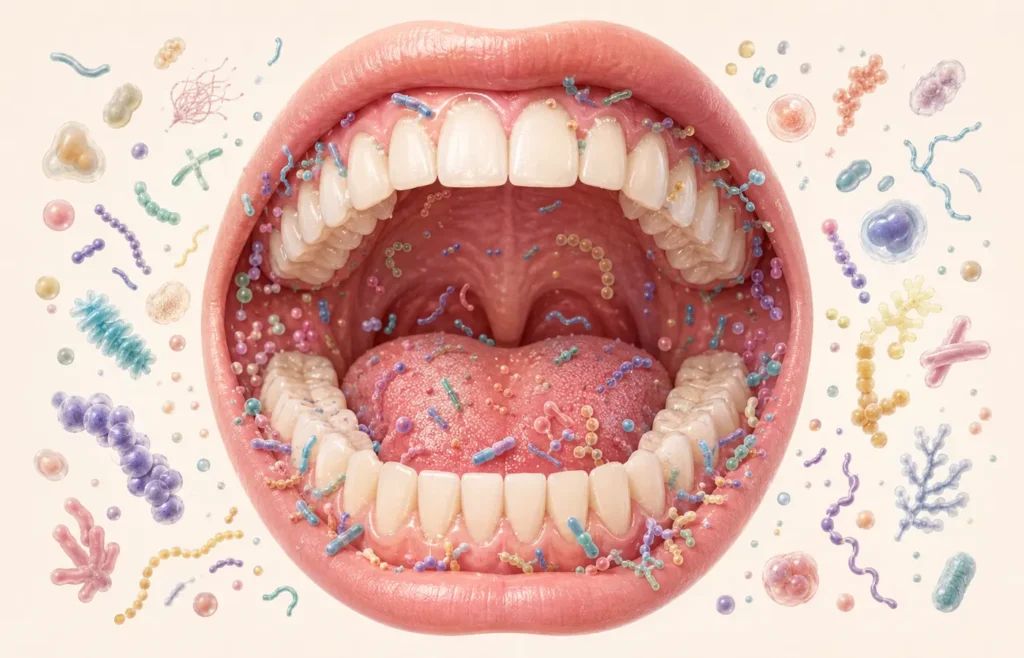
The mouth contains a complex community of bacteria, fungi, viruses and other microorganisms. Collectively, this community is known as the oral microbiome.
These microorganisms live on different surfaces, including the tongue, gums, teeth, saliva and areas below the gumline. A healthy mouth is not free of bacteria. Instead, oral health involves maintaining a relatively stable relationship between the microorganisms and their host.
Diet, oral hygiene, saliva, smoking, medications, health conditions and dental disease can influence this environment.
The idea behind oral microbiome probiotics is not simply to eliminate every bacterium. The goal is to support a more favorable microbial environment while limiting conditions that allow potentially harmful organisms to become dominant.
This biological concept is plausible, but translating it into a reliable commercial product is more complicated than adding a high number of microorganisms to a tablet.
What does research say about dental probiotics?
The available research usually focuses on particular strains and conditions. Studies also use different products, doses, delivery methods and follow-up periods, which makes direct comparisons difficult.
Probiotics and gum health
Periodontal research currently provides some of the more encouraging findings.
A 2024 systematic review and network meta-analysis examined 33 articles involving 1,290 patients. The researchers evaluated probiotics as an addition to professional mechanical plaque removal in people receiving non-surgical periodontal treatment.
Some probiotic interventions were associated with improvements in measurements such as probing pocket depth and clinical attachment level. Lactobacillus interventions produced some of the most substantial results in the analysis.
The important detail is that probiotics were evaluated as an adjunct to professional treatment. The findings do not show that a probiotic tablet can independently treat periodontitis or replace plaque removal performed by a dental professional.
People experiencing bleeding gums, gum recession, persistent swelling, loose teeth or pain should seek an appropriate dental evaluation rather than relying on a supplement.
Probiotics and dental cavities
Evidence concerning cavities is more uncertain.
A 2024 systematic review involving preschool children described the results as encouraging but also concluded that the overall level of evidence remained inadequate.
Another 2024 meta-analysis involving children and adolescents did not find a significant reduction in dental caries and classified the quality of evidence as low for that outcome.
These findings demonstrate why reductions in certain bacterial counts should not automatically be interpreted as proof that a product prevents cavities.
Cavity development is influenced by several factors, including sugar exposure, fluoride use, saliva, oral hygiene, dental anatomy and individual risk. Oral probiotics should not be used as a replacement for fluoride toothpaste or preventive dental care.
Probiotics and bad breath
Persistent bad breath can have several causes, including tongue coating, gum disease, dry mouth, dental decay, certain foods and medical conditions.
A 2025 systematic review and meta-analysis involving 10 studies found improvements in some measurements of halitosis, particularly when probiotic therapy was combined with conventional treatments.
However, the researchers also identified limitations such as small sample sizes, variation among the included trials and possible publication bias. These issues reduce certainty about how reliably the findings can be applied to different products and populations.
An oral probiotic may help support breath freshness for some people, but persistent or unexplained bad breath should be investigated instead of continually masked.
Why do the results vary between products?
The term “probiotic” describes a broad category rather than one standardized treatment. Several variables can change the expected effect.
Strain selection
Probiotic benefits can be strain-specific. Evidence concerning one strain should not automatically be transferred to another strain from the same species.
A label that lists only a general bacterial species provides less information than one that includes the complete strain designation.
Viable microorganisms
A large CFU number on the packaging does not necessarily mean that all those microorganisms remain viable until the product is consumed.
A 2023 laboratory study of 21 commercial oral probiotic products found that many products did not contain the claimed amount of viable cells or used inadequately characterized strains. Only five of the evaluated products contained probiotics that the researchers considered fully characterized and clinically supported for oral health.
The study did not evaluate ProDentim specifically, but it demonstrates why product quality and strain identification matter.
Delivery method
A dissolvable tablet, gum, mouthwash and swallowed capsule do not interact with the oral cavity in exactly the same way.
The amount of time a product remains in the mouth may influence rehydration, contact and adhesion. However, there is not yet one universally established delivery method or effective dose for every oral health objective.
Treatment duration
Research protocols range from a few weeks to several months. Short-term changes in microorganisms or clinical measurements do not necessarily establish a permanent benefit.
Claims of immediate or guaranteed results should therefore be approached cautiously.
Where does ProDentim fit into this category?
ProDentim is positioned as an oral probiotic supplement intended to complement a daily oral care routine.
The ProDentim label archived in the NIH Dietary Supplement Label Database lists a proprietary probiotic blend containing 3.5 billion CFU per serving. The archived formula identifies Lactobacillus paracasei, Lactobacillus reuteri and Bifidobacterium animalis subsp. lactis BL-04.
The database records product label information submitted for dietary supplements. Its presence in the database should not be interpreted as NIH approval, independent product testing or confirmation that the supplement produces a particular health outcome.
Because supplement formulas and labels can change, consumers should compare the information with the packaging they actually receive. Our detailed ProDentim ingredients guide explains the listed components in greater detail.
Research involving individual probiotic species or strains is relevant background information, but it does not prove that the complete ProDentim formula has the same effects. As of July 2026, we could not identify a peer-reviewed clinical trial evaluating the finished ProDentim formula as a whole.
That distinction is important. “Contains researched ingredients” is not equivalent to “the finished commercial product has been clinically proven.”
Readers who are unfamiliar with the supplement can begin with our guide explaining what ProDentim is.
Are oral probiotics safe?
Probiotics are generally unlikely to cause harm in healthy people, and reported side effects are often minor. Some people may experience temporary digestive symptoms such as gas.
However, the NIH Office of Dietary Supplements notes that serious infections have occasionally been reported, mainly in people who were severely ill or immunocompromised.
People who are pregnant, nursing, taking medication, managing a significant medical condition or living with a weakened immune system should speak with a qualified healthcare professional before using a probiotic supplement.
The product label and allergen information should also be checked carefully. Our guide to possible ProDentim side effects and safety checks covers these considerations in more detail.
How should you evaluate an oral probiotic?
Before selecting dental probiotics, consider the following questions:
- Does the label identify the genus, species and strain?
- Does it state the number of viable microorganisms?
- Is that amount guaranteed through expiration or only at manufacturing?
- Has the specific strain been studied for the intended outcome?
- Was the finished commercial formula studied, or only some ingredients?
- Does the company provide clear directions, warnings and contact information?
- Are the promises realistic and presented without guaranteed medical outcomes?
- Will the product be used alongside regular dental care rather than instead of it?
A larger CFU number does not automatically make one supplement better. According to the NIH, products with higher CFU counts are not necessarily more effective than products with lower counts.
Oral probiotics do not replace standard dental care
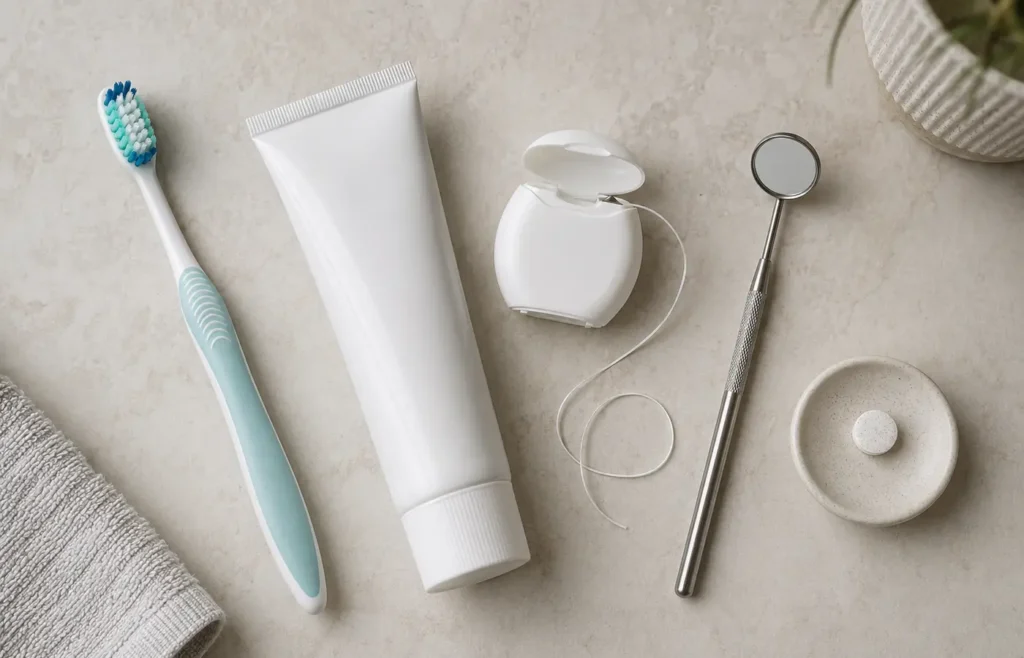
The foundation of oral health remains consistent daily care and professional evaluation when necessary.
The American Dental Association’s home-care guidance emphasizes brushing with fluoride toothpaste and cleaning between the teeth. Individual recommendations can vary depending on a person’s risk factors and oral health condition.
An oral probiotic should not replace:
- Brushing with an appropriate fluoride toothpaste.
- Cleaning between the teeth.
- Professional dental examinations.
- Treatment for cavities or periodontal disease.
- Investigation of persistent bleeding, pain, swelling or bad breath.
- Advice provided by a dentist or healthcare professional.
Anyone choosing ProDentim should follow the actual product label. Our practical guide explains how to take ProDentim and what its archived label recommends.
The bottom line
Oral probiotics for teeth and gums are a developing area of research. Some studies support their potential as an adjunct to conventional periodontal care and suggest possible short-term benefits for bad breath. Evidence for preventing cavities remains mixed and does not justify replacing established preventive measures.
The most responsible conclusion is neither that all dental probiotics work nor that the entire concept is ineffective. Results depend on the strain, dose, viability, formulation, condition being studied and the quality of the supporting evidence.
ProDentim belongs to this broader oral probiotic category, but evidence involving individual bacterial strains should not be presented as direct proof of the finished formula.
For a closer look at the product’s composition, limitations, purchasing considerations and affiliate offer, read our complete ProDentim review.
If you have already reviewed the evidence and decided that the product is appropriate for your routine, you can view the current ProDentim offer here.
This article is provided for educational purposes and does not replace advice, diagnosis or treatment from a qualified dental or healthcare professional.
Sources
- NIH Office of Dietary Supplements: Probiotics — Health Professional Fact Sheet
- Probiotics in the Non-Surgical Treatment of Periodontitis: Systematic Review and Network Meta-Analysis
- Efficacy and Safety of Probiotics for Dental Caries in Preschool Children
- Efficacy of Probiotic Consumption on Oral Outcomes in Children and Adolescents
- Efficacy and Safety of Probiotic Therapy for Halitosis
- Probiotics for Oral Health: Do They Deliver What They Promise?
- American Dental Association: Home Oral Care