Affiliate disclosure: This article contains affiliate links. If you purchase through our links, Only For U Deals may earn a commission at no additional cost to you.
The price of a vehicle history report is small compared with the cost of buying the wrong used car.
A hidden salvage title, odometer inconsistency, unpaid lien or serious reported accident can turn an attractive deal into an expensive problem.
VINCheckUp and Carfax both help buyers investigate those risks, but they are not priced or positioned in the same way.
Carfax is the more established premium service. It advertises a database containing more than 35 billion records from over 151,000 sources and is particularly strong in reported maintenance history and vehicle-specific valuation.
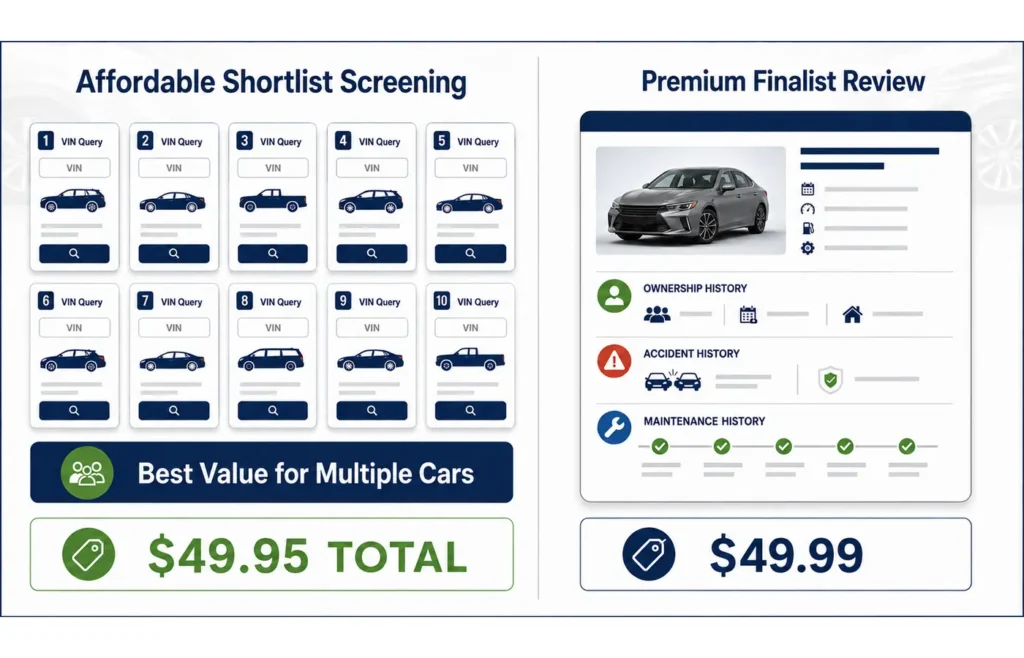
VINCheckUp takes a more affordable approach. It combines government and proprietary sources, presents title, accident, odometer, sale, lien, recall and possible auction information, and currently sells ten reports for approximately the price displayed for one Carfax report.
After comparing price, report content, data sources, purchase terms and practical value, our conclusion is:
VINCheckUp is the better value for most used-car shoppers, especially anyone comparing more than one vehicle.
Carfax may still be worth choosing when detailed service records, its History-Based Value or its limited Buyback Guarantee are the buyer’s highest priorities.
But if you need to screen several cars without spending nearly the cost of a report on every VIN, VINCheckUp gives you the more practical starting point.
Check the current VINCheckUp packages before researching your shortlist.
VINCheckUp vs Carfax at a glance
| Comparison | VINCheckUp | Carfax | Winner |
|---|---|---|---|
| One-report price reviewed | $19.95 | $49.99 displayed on the current sample report | VINCheckUp |
| Multi-report value | 3 reports for $29.95; 10 for $49.95 | Multi-report options may be available at checkout | VINCheckUp |
| Automatic monthly renewal | No monthly recurring billing | Verify the selected checkout offer | VINCheckUp for clarity |
| Accident and damage records | Yes, when reported and available | Yes, often with severity and impact location | Carfax |
| Title and brand checks | Yes | Yes | Tie |
| Odometer history | Yes | Yes | Tie |
| Service history | Possible dealer and maintenance records | Extensive reported service categories | Carfax |
| Sale, lien and auction information | May include sale records, liens, auction data and images | Detailed event timeline; information varies | VINCheckUp |
| Vehicle-specific value | Market-pricing estimates may appear | CARFAX History-Based Value | Carfax |
| NMVTIS-related information | Service states that reports use NMVTIS data | Consumer Carfax reports are not NMVTIS reports | VINCheckUp |
| Vehicle types promoted | Cars, trucks, vans, RVs and motorcycles | Primarily cars and light trucks since 1981 | VINCheckUp |
| Purchase protection | First-time satisfaction policy, subject to terms | Limited Buyback Guarantee for qualifying omitted title brands | Carfax |
| Best use | Screening one or several vehicles affordably | Deep review of a finalist | Depends on stage |
| Overall choice | Best value | Premium alternative | VINCheckUp wins |
Prices and package terms can change. Verify the checkout total before paying for either service.
The main difference between VINCheckUp and Carfax
The largest difference is not whether both services can show vehicle-history information.
They can.
The difference is how much buyers pay to investigate each vehicle and where each company appears to have the strongest data advantage.
VINCheckUp is designed as a lower-cost research tool. Its official sample report shows sections for:
- Accident records.
- Current and historical titles.
- Junk, salvage and total-loss events.
- Ownership history.
- Odometer readings and possible rollback indicators.
- Theft records.
- Recalls.
- Sale and lien information.
- Commercial or taxi use.
- Vehicle specifications.
- Market pricing.
- Possible listing and auction images.
Carfax covers many of the same fundamental risk categories. Its official report overview emphasizes accident severity, damage location, airbag deployment, structural damage, ownership, title brands, use type, recalls and service work.
The Carfax advantage is depth in areas such as reported oil changes, tire rotations, inspections and component replacement. Its History-Based Value also adjusts the vehicle’s estimated value using reported events.
That can be useful when you have already selected one vehicle and want the richest available ownership and maintenance timeline.
VINCheckUp’s advantage appears earlier in the buying process.
When five listings all look promising, the first job is not to pay a premium five times. It is to eliminate vehicles with obvious reported red flags as efficiently as possible.
VINCheckUp vs Carfax price comparison
The VINCheckUp pricing page displayed the following packages in August 2026:
| Package | Total price | Effective cost |
| 1 report | $19.95 | $19.95 per report |
| 3 reports | $29.95 | Approximately $9.98 per report |
| 10 reports | $49.95 | Approximately $5.00 per report |
VINCheckUp also states that it does not use monthly recurring subscription billing. Reports remain available in the customer’s search history for 30 days from the original purchase date.
The current official Carfax sample report displays a price of $49.99. Carfax can present additional package options during checkout, so buyers should verify the current selection and total before payment.
The strongest commercial difference is simple:
VINCheckUp currently offers ten reports for $49.95, while the Carfax sample displays $49.99 for one report.
For someone considering only one car, VINCheckUp still has the lower starting price.
For someone comparing three, five or ten cars, the difference becomes much larger.
The ten-report package is not automatically the right choice for everyone. Buy it only if you expect to research several VINs within the 30-day access period.
For many active used-car shoppers, however, it is the package that turns a report from a final-step expense into a practical screening tool.
View the current VINCheckUp price and select the number of reports you need.
Which report contains more information?
Carfax declares the larger data network.
According to the company, its database includes more than 35 billion records from over 151,000 domestic and international sources. The report can include data from government agencies, dealerships, service facilities, insurance-related sources, auctions, police departments, rental fleets and other contributors.
That breadth helps explain why Carfax often provides a more detailed maintenance timeline.
VINCheckUp says that it combines information from multiple government and proprietary sources. Its terms state that NMVTIS data is supplied by Vin, Inc., while its report may also include insurance, sales, lien, dealer, auction and listing information.
NMVTIS, the National Motor Vehicle Title Information System, is designed to help identify title fraud, branded titles, salvage history, total-loss information and other major risks. The U.S. Department of Justice explains that consumer Carfax reports are not NMVTIS reports; Carfax relies on its separate proprietary network for consumer products.
This does not make one database universally better.
Carfax may contain a service visit or damage event that does not appear in VINCheckUp. VINCheckUp may show a sale listing, lien, auction record or image that is useful to the buyer.
The amount of information always depends on the specific VIN and which events were reported to each source.
Which one is better for accident and title history?
Both services can identify reported accidents, title brands, salvage history, total-loss events, flood indicators and possible odometer problems.
Carfax has an advantage in presentation when detailed accident data is available. Its reports may classify damage as minor, moderate or severe and identify the area of impact, structural damage or airbag deployment.
VINCheckUp’s sample report also presents accident dates, severity, impact information, title events and a visible problem checklist. It can therefore provide enough information to reject a vehicle before arranging an inspection.
That distinction matters.
A history report does not need to tell you everything to save you money. If a lower-cost report identifies a salvage brand, rollback warning or unresolved lien on the first page, the buyer may already have the information needed to walk away.
For maximum accident detail on one chosen car, Carfax has the edge.
For affordable red-flag screening across several cars, VINCheckUp wins.
Which one is better for service records?
Carfax is the stronger choice for reported maintenance history.
Its reports may show oil changes, tire replacements, brake work, transmission service, inspections and other repairs in a dated timeline. This can help a buyer evaluate whether the previous owner appears to have maintained the vehicle consistently.
VINCheckUp says its reports may include dealer maintenance and manufacturer-recommended service records, but buyers should not assume that every report will contain the same level of detail.
Neither service receives every repair record.
Work performed by an independent mechanic, a small shop or the owner may never be submitted to any vehicle-history database. Ask the seller for invoices and maintenance records even when the report looks complete.
Which service has better buyer protection?
The protections are different and should not be treated as equivalent.
VINCheckUp’s terms describe a satisfaction guarantee for first-time subscribers. Refunds are handled case by case. The same section refers to both a 30-day guarantee and a four-week refund limit.
Because four weeks is shorter than 30 days, a dissatisfied buyer should contact support within 28 days of the original purchase rather than waiting until day 30.
Carfax offers a Buyback Guarantee tied to specific DMV-issued title brands. If a qualifying brand—such as salvage, junk, rebuilt, fire, flood, hail, lemon or certain odometer brands—was reported by a DMV but omitted from the Carfax report, the buyer may qualify under the program’s full terms.
This is not a general money-back promise for an incomplete service history or an unreported accident.
Still, it is a meaningful advantage for the narrow title problems it covers.
Carfax wins on formal title-brand protection. VINCheckUp provides the more clearly affordable purchase.
How accurate are VINCheckUp and Carfax?
No vehicle history report can guarantee a complete history.
VINCheckUp states that its information may not always be accurate or current because availability depends on outside sources. Carfax also states that it does not have the complete history of every vehicle.
An accident paid privately may never reach an insurer. A repair shop may not report its work. A state record may be delayed. Damage can exist without a total-loss decision or branded title.
For that reason, the U.S. Department of Justice recommends combining a vehicle-history report with an independent inspection and other available vehicle information.
Use either report to decide what needs closer investigation—not as proof that nothing happened.
Before buying, also:
- Confirm that the VIN matches the dashboard, door label, title and listing.
- Review the physical title and seller identification.
- Test-drive the vehicle.
- Ask for service invoices.
- Check for mismatched paint, uneven gaps, corrosion and water damage.
- Have an independent mechanic inspect the car.
- Verify any lien has been properly released.
The smartest way to use VINCheckUp and Carfax
The most cost-effective strategy is not always choosing one service for the entire purchase.
Use VINCheckUp to screen the shortlist.
If you are comparing several cars, run the VINs before driving across town, paying for inspections or negotiating with sellers. Remove vehicles with serious reported title, accident, mileage, theft or lien problems.
Then investigate the finalist more deeply.
Ask the dealer or private seller whether a recent Carfax report is already available. Used vehicles listed directly on Carfax include a free report, and many dealers provide one without requiring the buyer to purchase it separately.
If no Carfax is available and detailed service history matters for that specific vehicle, decide whether the additional report is worth the cost.
This process gives each service the job it performs best:
- VINCheckUp controls the cost of initial screening.
- Carfax can add detail to the final evaluation.
- The mechanic checks what databases cannot see.
For more detail about the lower-cost service, read our complete VINCheckUp vehicle history report review.
Who should choose VINCheckUp?
VINCheckUp is the better fit if you:
- Are comparing multiple used vehicles.
- Want a lower starting price.
- Need title, accident, odometer, theft, recall, lien and sale information.
- Value possible auction records and vehicle images.
- Want to research cars, trucks, vans, RVs or motorcycles.
- Prefer a one-time purchase without monthly recurring billing.
- Plan to use the report as an initial screening tool.
- Will still obtain an independent inspection.
The strongest package depends on the size of your shortlist.
One report is suitable when you have already selected a vehicle. Three reports offer a better balance for a small shortlist. Ten reports provide the lowest cost per VIN and the greatest value for an active search.
Who should choose Carfax?
Carfax may be the better fit if you:
- Want the broadest declared source network.
- Prioritize detailed maintenance and repair history.
- Want CARFAX History-Based Value.
- Value its limited Buyback Guarantee.
- Are evaluating one final car rather than a large shortlist.
- Can access a report free through a dealer or Carfax listing.
- Are comfortable paying more for a premium report.
Carfax is not overpriced simply because a cheaper alternative exists.
Its value depends on whether the additional records it may contain are important to your decision.
Frequently asked questions
Is VINCheckUp better than Carfax?
VINCheckUp is better for price and multi-vehicle screening. Carfax is stronger for detailed reported service history, its vehicle-specific value and its limited title-brand Buyback Guarantee. VINCheckUp is the better overall value for most buyers comparing several vehicles.
Is VINCheckUp a good Carfax alternative?
Yes. VINCheckUp covers many of the risk categories buyers expect from a paid vehicle-history report, including accidents, title brands, mileage, theft, recalls, ownership, liens and sale records. It should not be described as identical to Carfax because the services use different data networks.
Is VINCheckUp cheaper than Carfax?
Yes, based on the prices reviewed in August 2026. VINCheckUp displayed one report for $19.95, three for $29.95 and ten for $49.95. The current Carfax sample report displayed $49.99. Always verify live pricing before payment.
Does VINCheckUp show accidents?
VINCheckUp can show reported accident dates, severity and other details when available. No report can reveal an accident that was never reported to one of its data sources.
Does VINCheckUp have service records?
VINCheckUp says reports may include dealer maintenance and recommended service records. Carfax generally places greater emphasis on detailed service-history events, but information still varies by VIN.
Can a clean report prove that a used car has no damage?
No. A clean report means no relevant problem was found in the data available to that service. It does not prove that the vehicle was never damaged, repaired or poorly maintained.
Should I buy both VINCheckUp and Carfax?
Not for every vehicle. A practical approach is to use VINCheckUp for the shortlist, obtain a free Carfax from the seller or listing when available, and consider purchasing a Carfax only for a finalist when additional maintenance detail could affect the decision.
Final verdict: VINCheckUp or Carfax?
Carfax remains the premium option.
It offers a larger declared data network, strong service-history detail, a vehicle-specific valuation and limited protection against certain omitted DMV title brands.
But most used-car buyers do not begin with one perfect vehicle.
They begin with a list.
They compare advertisements, contact sellers, inspect photos and eliminate vehicles until one or two serious candidates remain.
That is where VINCheckUp provides the stronger value.
It currently offers:
- One report for less than half the price displayed on the Carfax sample.
- Three reports for $29.95.
- Ten reports for approximately the displayed cost of one Carfax report.
- No monthly recurring billing.
- Accident, title, odometer, theft, recall, ownership, sale and lien checks.
- Possible auction records and historical vehicle images.
- Coverage promoted for cars, trucks, vans, RVs and motorcycles.
VINCheckUp does not guarantee that every event will appear.
Neither does Carfax.
The responsible decision is to use a report to identify documented risks, verify the vehicle and then obtain an independent inspection.
For buyers who want the deepest possible reported service timeline on one finalist, Carfax may justify its premium.
For buyers who want to investigate more vehicles, control research costs and avoid spending premium-report prices before the shortlist is ready, VINCheckUp is the better overall choice.
The report is not the expensive part of buying a used car.
The expensive part is discovering the warning sign after the purchase.
Check your VIN with VINCheckUp before deciding which car deserves your time and money.
Disclaimer: Vehicle-history information depends on records reported to third-party sources. A report does not replace a title review, test drive or independent inspection by a qualified mechanic.
Sources
- Official VINCheckUp Pricing
- Official VINCheckUp Sample Report
- VINCheckUp Terms and Satisfaction Policy
- How VINCheckUp Describes Its Data and Features
- Official CARFAX Vehicle History Report Overview
- Official CARFAX Sample Report
- About CARFAX and Its Data Network
- CARFAX Buyback Guarantee Explanation
- U.S. Department of Justice: Approved NMVTIS Data Providers
- U.S. Department of Justice: Understanding an NMVTIS Report