Affiliate disclosure: This article contains affiliate links. If you purchase through our links, Only For U Deals may earn a commission at no additional cost to you.
A vehicle-history report can cost less than a tank of gas.
Buying the wrong used car can cost thousands of dollars.
That difference explains why buyers want to investigate a vehicle before paying—but it also explains why they hesitate to enter a credit card on a VIN-report website they do not recognize.
So, is VINCheckUp legit, or is it a scam?
After examining its report process, data disclosures, pricing, billing terms, satisfaction policy, customer-support information and Better Business Bureau profile, our conclusion is:
VINCheckUp appears to be a legitimate vehicle-history report service, not a fake website that simply takes payment without delivering a product.
The service provides paid reports, publishes a sample, identifies the types of records it searches, maintains terms and privacy policies, offers customer support and states that its purchases do not renew automatically every month.
However, legitimate does not mean perfect.
VINCheckUp cannot guarantee that every accident, repair, ownership event or title problem will appear in a report. Its satisfaction policy also contains wording buyers should understand before purchasing.
If you approach it as an affordable research tool—not as a guarantee that a car has no hidden problems—VINCheckUp can provide useful information before you spend time and money on a used vehicle.
Check your VIN and view the current VINCheckUp report options.
VINCheckUp legitimacy check
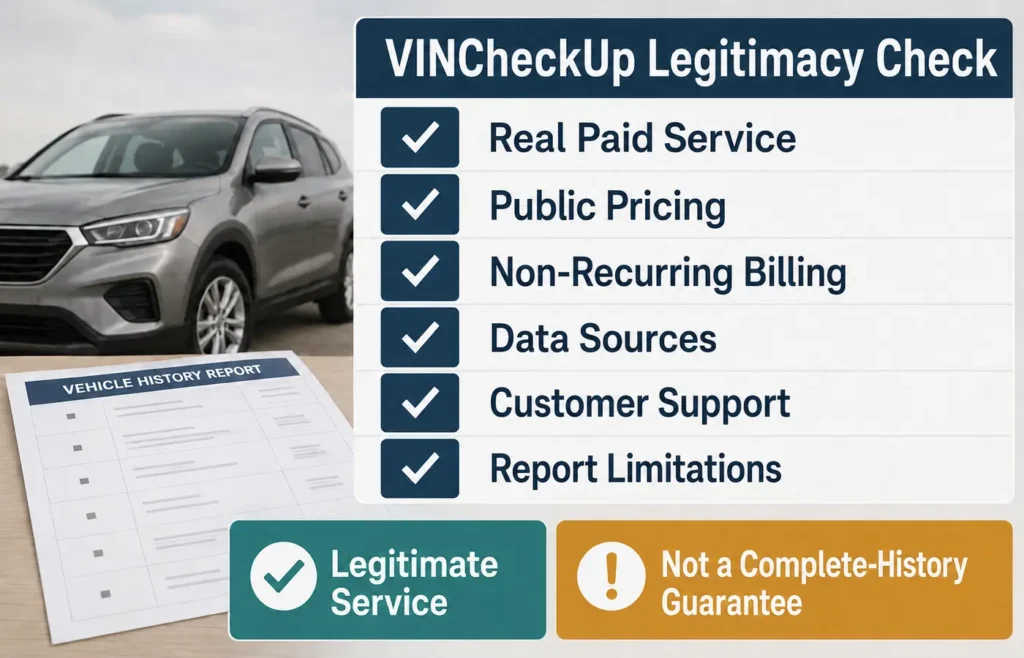
| Verification point | What we found |
|---|---|
| Real paid service | Yes. VINCheckUp delivers vehicle-history reports after a VIN search and purchase |
| Public sample report | Yes |
| Public pricing | Yes |
| Automatic monthly billing | The company states that purchases are non-recurring |
| Data sources disclosed | Government and proprietary sources, including NMVTIS-related data |
| Customer support | Online support, telephone number and published hours |
| Terms and privacy policy | Both are publicly available |
| BBB profile | A rating, but not BBB accredited |
| Satisfaction policy | Available to qualifying first-time customers and handled case by case |
| Complete-history guarantee | No |
| Replacement for an inspection | No |
| Overall conclusion | Legitimate service with important limitations |
The most important distinction is this:
VINCheckUp can be a real service even when a particular report contains fewer records than the buyer expected.
Vehicle-history companies do not personally investigate each car. They aggregate records from government agencies, insurers, auctions, dealers and other sources.
If an accident or repair was never reported to one of those sources, the service cannot reliably display it.
Why do people question whether VINCheckUp is legitimate?
There are several understandable reasons.
VINCheckUp is less familiar than Carfax
Carfax is the name many American buyers already associate with vehicle-history reports.
A lower-priced alternative may therefore create suspicion, especially when buyers are being asked to enter payment information.
Being less famous does not make a company fraudulent.
The better test is whether the service explains what it sells, how much it costs, where the information comes from and what limitations apply.
VINCheckUp provides that information across its pricing, sample-report, FAQ, terms and privacy pages.
The preliminary VIN search is not the complete paid report
VINCheckUp allows visitors to enter a VIN and receive preliminary vehicle information before purchasing.
According to its official terms, these free preliminary and VIN-decoder searches are intended to verify basic vehicle details. The complete paid report is accessed through the member area.
A buyer expecting the preliminary search to reveal the entire accident, title and ownership history may assume that information has been withheld unexpectedly.
The distinction should be understood before payment:
- The preliminary lookup provides basic VIN-related information.
- The paid report searches for additional history records.
- The amount of information in the paid report still depends on data availability.
VIN-report scams do exist
The Federal Trade Commission has warned about scams targeting people who advertise vehicles online.
A supposed buyer contacts the seller, appears interested in the car and then insists that the seller purchase a report from one specific unfamiliar website. After the seller pays, the supposed buyer disappears.
That warning does not mean every paid vehicle-history website is a scam.
It does mean sellers should be careful when a stranger sends them a report link and pressures them to pay immediately.
If you want to use VINCheckUp, access the correct website independently. Do not trust a look-alike domain simply because a stranger sent it to you.
What does VINCheckUp actually provide?
The official VINCheckUp sample report shows that a report may include:
- Accident and damage records.
- Current and historical title information.
- Salvage, junk, rebuilt and total-loss records.
- Odometer readings and possible inconsistencies.
- Theft and theft-recovery information.
- Ownership history.
- Sale records.
- Lien information.
- Open recalls.
- Commercial, rental or taxi use.
- Vehicle specifications.
- Market-value information.
- Auction records.
- Possible auction or listing images.
- Reported maintenance and service events.
Not every VIN will contain every section or record.
A vehicle with extensive reported history may produce a detailed timeline. Another vehicle may return only basic specifications, title information, recalls and a limited number of recorded events.
That variation is not unique to VINCheckUp. Every vehicle-history report depends on the information supplied to its databases.
Where does VINCheckUp get its information?
VINCheckUp states that it collects information from government and proprietary sources.
Its FAQ identifies the National Motor Vehicle Title Information System, or NMVTIS, as a primary source. NMVTIS is a federal system designed to help consumers identify risks involving titles, brands, salvage vehicles, total-loss declarations and odometer information.
The VINCheckUp terms state that the connection used to compile NMVTIS information was tested and approved by the American Association of Motor Vehicle Administrators. They also identify Vin, Inc. as the authorized provider supplying the NMVTIS data.
There is an important distinction here.
The current Department of Justice list of approved NMVTIS providers does not display VINCheckUp itself by name as a direct public provider.
Therefore, buyers should not interpret the service as being endorsed or approved by the federal government.
The more accurate conclusion is:
- VINCheckUp states that its reports incorporate NMVTIS information.
- Its terms identify the authorized data supplier used for that information.
- Government data is only one part of the report.
- Government involvement with NMVTIS is not an endorsement of VINCheckUp or a guarantee that every report is complete.
This is still a meaningful source for title-related research, provided buyers understand what the database can and cannot show.
Is VINCheckUp BBB accredited?
No.
The Better Business Bureau profile for VINCheckUp currently gives the business an A rating, but clearly states that VINCheckUp is not BBB accredited.
These are different concepts.
A BBB rating reflects the organization’s assessment of factors such as complaint history, business practices and time in operation. Accreditation is a separate voluntary process.
The profile also includes negative customer reviews.
Some reviewers report that their purchased report contained less useful information than expected. For example, buyers may receive specifications and recall information but not find the accident, theft or repair record they hoped to uncover.
Those complaints should not be ignored.
They reinforce one of the service’s central limitations: paying for a report does not guarantee that a particular event exists in the available databases.
At the same time, a limited report does not automatically prove that the company is a scam. It may mean that the event was never reported, was reported to a different source or is not included in the specific databases searched.
The BBB rating is one positive legitimacy indicator, but it should not be mistaken for:
- BBB accreditation.
- A BBB endorsement.
- Proof that every customer is satisfied.
- Proof that every report will contain extensive information.
Does VINCheckUp charge a monthly subscription?
According to the company’s current terms, no.
VINCheckUp describes its membership as non-recurring, meaning the buyer pays once and is not automatically billed every month.
Its pricing page also states that the service does not support monthly recurring subscription billing.
Reports remain available in the customer’s search history for 30 days from the original purchase date. During that period, the customer may view, download and print the reports while the account remains active.
This billing structure is an advantage for buyers who want to check a shortlist of vehicles without taking on another monthly subscription.
Nevertheless, always inspect the checkout page before completing payment.
Confirm:
- The number of reports included.
- The total amount charged.
- Whether an optional product has been added.
- How long report access remains available.
- The email address attached to the account.
Save the order confirmation and download every report you want to keep before the access period ends.
How much does VINCheckUp cost?
The packages reviewed in August 2026 displayed:
| Package | Total price | Effective cost |
|---|---|---|
| 1 vehicle-history report | $19.95 | $19.95 per report |
| 3 vehicle-history reports | $29.95 | Approximately $9.98 per report |
| 10 vehicle-history reports | $49.95 | Approximately $5.00 per report |
Prices and access packages can change.
The single-report option requires the lowest initial payment.
The three-report option is more practical for buyers who have not selected one final car. It allows you to investigate several candidates without purchasing each report separately.
The ten-report package offers the lowest effective cost and is designed for an active shopper comparing a larger number of listings.
The best value depends on your buying process:
- Choose one report if you already have a strong finalist.
- Choose three reports if you are building a short list.
- Choose ten reports if you expect to investigate multiple listings during the 30-day period.
The potential value does not come from receiving ten files.
It comes from eliminating a questionable vehicle before paying for travel, a mechanic, financing or the car itself.
View the current VINCheckUp packages before choosing how many vehicles to research.
Does VINCheckUp offer refunds?
VINCheckUp publishes a satisfaction policy for first-time customers, but the wording requires attention.
Its terms first describe a 30-day satisfaction guarantee. The next paragraph states that the refund policy is limited to four weeks and that refunds cannot be issued after that period.
Four weeks equals 28 days, not 30 days.
The safest approach is to follow the shorter period.
If you are dissatisfied:
- Contact customer support as soon as possible.
- Do not wait longer than 28 days from the original purchase.
- Use the email address associated with your account.
- Include the order or receipt number.
- Explain the issue clearly.
- Keep a copy of the support request and response.
The policy also says that refunds are handled case by case and that the satisfaction guarantee applies only to qualifying first-time customers.
This is not the same as an unconditional, automatic refund promise.
The difference between “30 days” and “four weeks” is an inconsistency the company should ideally clarify. Until it does, buyers should assume the four-week limit controls.
Is VINCheckUp safe to use?
VINCheckUp states that its checkout information is encrypted using SSL and that it uses technical, administrative and physical safeguards.
The service also publishes a privacy policy explaining the categories of information it collects, including order information, account information and passive usage data.
These are positive signs, but they do not constitute an independent security audit.
Use the same precautions you would use with any online purchase:
- Confirm that the address begins with
https://www.vincheckup.com/. - Avoid look-alike domains.
- Do not purchase through a link sent by an unknown buyer.
- Use a unique password.
- Keep the payment receipt.
- Review the card statement after purchasing.
- Do not send payment information through email or voicemail.
- Access customer support through the official website.
An affiliate link may redirect you to the official checkout, but the final domain should still be inspected before payment.
How accurate is a VINCheckUp report?
A VINCheckUp report can accurately reproduce records available through its sources while still missing an event that occurred in real life.
That is because accuracy and completeness are not the same.
Consider these examples:
- An accident paid privately may never be reported to an insurer.
- An owner may repair damage at home.
- A small repair shop may not submit service records.
- A state database may update information later.
- Damage may occur without the vehicle being declared a total loss.
- An insurance company may declare a total loss before a state applies a salvage brand.
- A lien may require additional verification with the relevant authority.
VINCheckUp openly states that it does not create or validate the underlying NMVTIS records and cannot guarantee that all information is accurate, current or complete.
That limitation should not prevent you from using a report.
It should change how you use it.
A report is best treated as a red-flag detector.
If it reveals a salvage title, odometer inconsistency, flood record, unresolved lien or serious accident, you have a concrete reason to investigate further or reject the vehicle.
If it returns a clean history, you have one positive piece of information—but not proof that the car has never been damaged.
Can a clean VINCheckUp report guarantee a good car?
No.
A clean report means the service did not identify a major problem in the records it accessed. It does not prove that no problem exists.
The FTC recommends combining a vehicle-history report with an independent mechanical inspection. A report may reveal accidents and flood damage, but it generally cannot diagnose current mechanical problems.
Before purchasing any used vehicle:
- Match the VIN on the dashboard, door label, title and advertisement.
- Examine the physical title.
- Verify that the seller has the legal authority to sell the vehicle.
- Ask for maintenance invoices.
- Test-drive the car.
- Check for unusual noises, warning lights and fluid leaks.
- Inspect for mismatched paint, uneven panel gaps and corrosion.
- Have an independent mechanic inspect it.
- Confirm that any reported lien has been released.
- Compare the report with the seller’s claims.
If the seller refuses an independent inspection, that refusal may tell you more than a clean report.
VINCheckUp complaints: what should buyers realistically expect?
The most important complaint category involves reports that contain fewer useful records than expected.
That risk is real.
VINCheckUp’s terms state that customers may be charged for a report even when it contains incorrect information, no information or fewer records than expected.
That clause is strict, but it is also publicly disclosed.
Buyers should therefore purchase for the correct reason.
Do not buy because you expect VINCheckUp to prove that a specific accident occurred.
Buy because you want to search available records for potential problems before risking significantly more money on the vehicle.
A report that identifies one hidden title brand can be extremely valuable.
A report that contains no meaningful history may feel disappointing.
Both outcomes are possible because the service can only return information connected to that VIN through its available sources.
Who should use VINCheckUp?
VINCheckUp is a strong fit if you:
- Are buying a used vehicle.
- Want to screen a vehicle before arranging an inspection.
- Are comparing several listings.
- Want a lower-cost alternative to premium reports.
- Need title, salvage, total-loss or odometer information.
- Want to check for reported accidents, recalls, liens or theft records.
- Understand that only reported events can appear.
- Plan to combine the report with a mechanical inspection.
- Prefer a non-recurring purchase.
- Can use the reports within the 30-day access period.
It is particularly attractive for someone comparing several vehicles.
Spending approximately $5 per VIN through the ten-report package can make it easier to remove weak candidates before investing more time in them.
Who should not rely on VINCheckUp alone?
VINCheckUp should not be your only research method if:
- You need a guaranteed complete maintenance history.
- You expect the report to include the previous owner’s name or address.
- You are researching a vehicle manufactured before VINs were standardized in 1981.
- You believe a clean report removes the need for an inspection.
- You need proof that an unreported accident never occurred.
- You are buying a high-value, classic, exotic or heavily modified vehicle.
- The title documents appear inconsistent.
- The seller’s identity or behavior raises concerns.
For more detail about the report sections, benefits and purchasing options, read our complete VINCheckUp vehicle history report review.
How to use VINCheckUp without wasting a report
Before running the paid search:
- Copy the VIN directly from the vehicle or official document.
- Confirm that it contains exactly 17 characters.
- Compare it with the VIN shown in the advertisement.
- Make sure the letters I, O and Q were not entered by mistake.
- Use the preliminary lookup to confirm the year, make and model.
- Verify that the vehicle information matches the seller’s description.
- Only then use one of your paid reports.
After receiving the report:
- Download or print it.
- Review the problem checklist first.
- Examine every title and odometer event.
- Compare accident dates with the seller’s story.
- Look for long gaps in the timeline.
- Inspect any available auction images.
- Write down questions for the seller or mechanic.
- Keep the report with the purchase documents.
This process turns the report into a negotiation and screening tool instead of a document you open once and forget.
Frequently asked questions
Is VINCheckUp a legitimate company?
VINCheckUp appears to be a legitimate vehicle-history service. It provides paid reports, publishes pricing and sample information, maintains terms and privacy policies, offers customer support and has an active BBB business profile. That does not guarantee that every report will be complete.
Is VINCheckUp a scam?
The evidence reviewed does not indicate that VINCheckUp is simply a fake service that takes payment without delivering reports. However, customers can receive limited information when few events were reported for the VIN. Buyers should understand the data and refund limitations before paying.
Is VINCheckUp BBB accredited?
No. VINCheckUp is not BBB accredited. Its current BBB profile displays an A rating, which is separate from accreditation and should not be interpreted as an endorsement.
Does VINCheckUp use NMVTIS information?
VINCheckUp states that its reports include NMVTIS information and identifies Vin, Inc. as its authorized NMVTIS data provider. VINCheckUp itself is not currently displayed by name on the Department of Justice public-provider list.
Does VINCheckUp charge every month?
The company states that its purchases are non-recurring and that customers are not automatically billed monthly. Always verify the final checkout conditions before paying.
Is the VINCheckUp free search a complete report?
No. The free preliminary search is intended to confirm basic vehicle information. A complete vehicle-history report requires a paid report credit.
Can VINCheckUp miss an accident?
Yes. Any vehicle-history service can miss an accident that was not reported to its data sources. A clean report should always be combined with a physical and mechanical inspection.
Can I get a VINCheckUp refund?
Qualifying first-time customers may request assistance under the satisfaction policy. Refunds are handled case by case. Because the terms mention both 30 days and four weeks, contact support within 28 days of the original purchase.
How long can I access my reports?
VINCheckUp states that reports are available through the member search history for 30 days from the original purchase date. Download the reports you want to keep during that period.
Which VINCheckUp package offers the best value?
The ten-report package offers the lowest effective cost per report. The three-report option may provide a better balance for a buyer comparing a smaller shortlist. Verify current prices before purchasing.
Final verdict: Is VINCheckUp legit?
VINCheckUp appears to be a legitimate vehicle-history report service.
Buyers can verify:
- A functioning report process.
- Public prices.
- A sample report.
- Identified report categories.
- NMVTIS-related data disclosures.
- Non-recurring billing terms.
- Customer-support channels.
- A satisfaction policy.
- Terms and privacy documents.
- An active BBB profile with an A rating.
But legitimate does not mean guaranteed.
VINCheckUp cannot promise that every accident, repair, lien, mileage event or title problem was reported to its sources.
Its satisfaction policy is also conditional, and buyers should follow the shorter four-week request period stated in the terms.
The correct purchasing decision is not based on expecting a perfect record of the car’s life.
It is based on comparing the small cost of a report with the much larger financial risk of buying a vehicle without investigating its history.
For active shoppers, VINCheckUp’s multi-report packages make it possible to screen several vehicles affordably.
Use the report to identify reported warning signs. Use an independent mechanic to identify the problems no database can see.
Together, those steps create a much safer used-car buying process.
Check the VIN and view the current VINCheckUp report packages.
Disclaimer: Vehicle-history information depends on records reported to third-party sources. A report does not replace a title review, test drive or independent inspection by a qualified mechanic.
Sources
- Official VINCheckUp Pricing
- Official VINCheckUp Sample Report
- Official VINCheckUp Terms and Satisfaction Policy
- Official VINCheckUp FAQ
- Official VINCheckUp Privacy Policy
- Official VINCheckUp About Page
- VINCheckUp Better Business Bureau Profile
- Department of Justice NMVTIS Provider List
- FTC Warning About Vehicle-History Report Scams
- FTC Guidance for Buying a Used Car