Affiliate disclosure: This article contains affiliate links. If you purchase through our links, Only For U Deals may earn a commission at no additional cost to you.
You found a used car that looks right.
The price fits your budget. The photos are clean. The seller says it runs perfectly—and another buyer may come to see it soon.
This is exactly when you should stop and check the VIN.
Do not choose the car first and investigate its history later.
Once you imagine yourself driving it, negotiate the price or spend hours visiting the seller, walking away becomes much harder. A vehicle-history report is most valuable before emotional commitment turns into financial commitment.
A VINCheckUp report may reveal reported title problems, accident records, odometer inconsistencies, salvage history, total-loss events, liens, theft records and other warning signs connected to the vehicle.
For a detailed overview of the records, limitations and best use cases, read our VINCheckUp vehicle history report review.
The report costs far less than discovering one of those problems after the purchase.
Check the VIN before you commit to the car.
Why checking the VIN early matters
Many buyers wait until they believe they have found “the one.”
They visit the dealership, take a test drive, discuss financing and begin imagining the vehicle in their driveway. Only then do they think about checking its history.
That order creates unnecessary pressure.
At that point, you may already have:
- Driven a long distance to see the vehicle.
- Paid for transportation or taken time away from work.
- Negotiated with the seller.
- Started a credit application.
- Scheduled a mechanical inspection.
- Convinced yourself that small warning signs do not matter.
- Felt pressured because another buyer is supposedly interested.
The more time and emotion you invest, the easier it becomes to rationalize information that should make you walk away.
Checking the VIN earlier changes the process.
Instead of asking, “Can I overlook this problem because I already want the car?” you can ask the better question:
“Does this vehicle deserve any more of my time and money?”
What could a vehicle-history report reveal?
A VINCheckUp report may search available records for:
- Reported accidents and damage.
- Salvage, rebuilt or junk titles.
- Total-loss declarations.
- Flood or fire history.
- Odometer readings and possible mileage inconsistencies.
- Theft and recovery records.
- Ownership and title events.
- Reported liens.
- Auction or sale history.
- Possible auction photographs.
- Commercial, rental or taxi use.
- Open recalls.
Not every report will contain every type of information. Vehicle-history services depend on records reported to their available sources.
However, you do not need the report to reveal everything for it to be valuable.
One serious title problem, mileage discrepancy or previously undisclosed accident may be enough to remove a vehicle from your list before it becomes your problem.
The cost of waiting can be much higher
A report is a small research expense.
A bad used-car purchase can involve:
- Unexpected repair bills.
- Difficulty obtaining insurance.
- Lower resale value.
- Financing problems.
- Safety concerns.
- Title complications.
- Lost time dealing with the seller or dealership.
- Thousands of dollars tied to the wrong vehicle.
The current VINCheckUp packages reviewed in August 2026 are:
| Package | Price | Best for |
|---|---|---|
| 1 report | $19.95 | One confirmed finalist |
| 3 reports | $29.95 | Buyers comparing a shortlist |
| 10 reports | $49.95 | Active shoppers checking several vehicles |
For most buyers who are still choosing, the three-report package is the strongest balance.
It costs only $10 more than one report and allows you to investigate three candidates. If the first vehicle presents a serious warning sign, you can move to the next option without purchasing another individual report.
The ten-report package offers the lowest effective cost per VIN for someone actively reviewing several listings.
View the current report packages and start your VIN search.
Do not let urgency come only from the seller
Used-car listings can move quickly. A seller may tell you that someone else is interested or that the advertised price will not last.
That does not mean you should skip your research.
If the vehicle sells while you investigate, the outcome may be disappointing.
Buying a vehicle with a hidden title, mileage or damage problem can be significantly more expensive.
Real urgency should come from protecting yourself before:
- Sending a deposit.
- Applying for financing.
- Paying for an inspection.
- Traveling to another city.
- Signing paperwork.
- Becoming emotionally committed to the vehicle.
A legitimate seller should understand why a serious buyer wants to review the vehicle’s history.
Be cautious if the seller refuses to provide the complete VIN, gives you a VIN that does not match the car or pressures you to pay before you can investigate.
The right order for choosing a used car
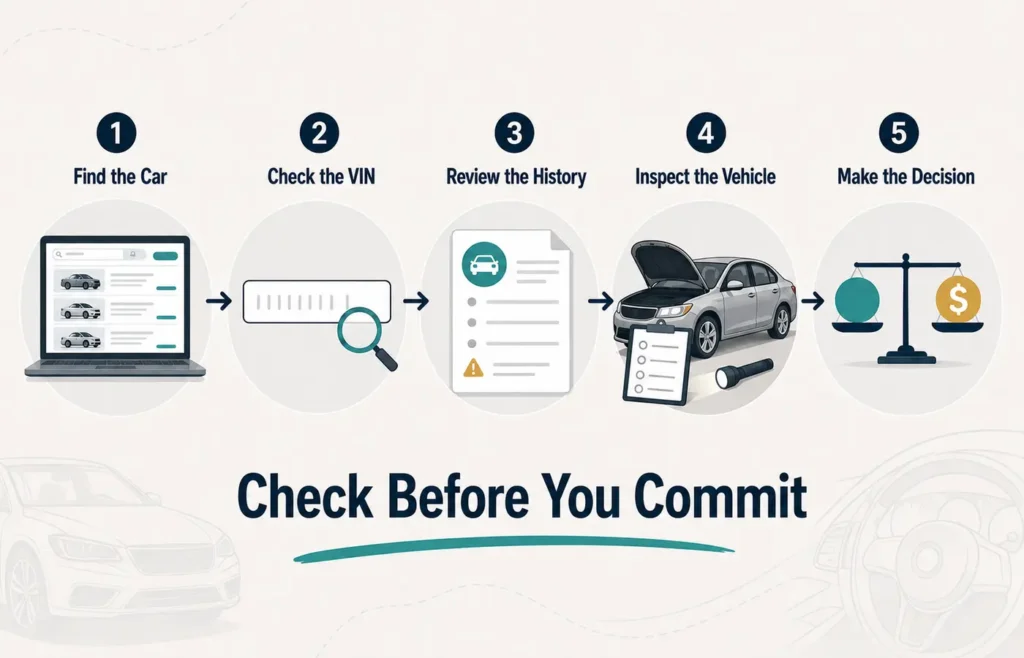
Use this sequence:
- Find a promising listing.
- Request the complete 17-character VIN.
- Confirm that the VIN matches the advertised year, make and model.
- Run the vehicle-history report.
- Review title, accident, mileage and ownership records.
- Decide whether the car deserves a test drive.
- Arrange an independent mechanical inspection.
- Negotiate only after understanding the vehicle’s history and condition.
- Complete the purchase if the evidence supports it.
This process does not eliminate every risk.
It does help you spend more time on stronger vehicles and reject questionable ones before they consume additional money.
A clean report is not the final approval
A vehicle-history report cannot prove that an accident never happened.
Some repairs, accidents or damage events may never have been reported to the databases searched by the service.
That is why the Federal Trade Commission recommends obtaining both a vehicle-history report and an independent inspection before purchasing a used car.
These steps answer different questions:
- The history report investigates reported events from the past.
- The mechanic evaluates the vehicle’s current physical and mechanical condition.
Use both before making the final decision.
A clean report is a reason to continue your research—not a reason to stop researching.
Frequently asked questions
Should I check the VIN before seeing the car?
If the listing appears serious and the seller provides a valid VIN, checking the history before traveling may save you time and money. You can remove vehicles with major reported warning signs before arranging a visit.
Is one report enough?
One report may be enough if you already have a strong finalist. If you are still choosing between vehicles, a multi-report package provides more flexibility and a lower effective cost per VIN.
Can VINCheckUp tell me whether the car is mechanically reliable?
No. A vehicle-history report may reveal reported accidents, title events, mileage records and other historical information. A qualified mechanic should inspect the vehicle’s current condition.
What if the report does not show any accidents?
That means no accident was identified in the records searched. It does not guarantee that the car has never been damaged or repaired.
When should I purchase the report package?
Purchase when you are actively shopping and have valid vehicles to investigate. VINCheckUp currently states that reports are stored in the member area and available for download for 30 days from the original purchase date.
Final decision: check first, choose second
The wrong time to discover a serious problem is after you have paid for the car.
The second-worst time is after you have already spent money, time and emotional energy pursuing it.
The right time is now—while walking away is still easy.
Before visiting the seller, arranging financing or deciding that you have found the perfect vehicle, check what its VIN may reveal.
You may confirm that the car deserves the next step.
Or you may discover a reason to avoid a decision that could cost thousands of dollars.
Either result is valuable.
Enter the VIN and check the vehicle’s reported history before you choose.
Disclaimer: Vehicle-history reports depend on records available from third-party sources and may not contain every accident, repair or ownership event. A report does not replace a title review, test drive or independent inspection by a qualified mechanic.