
Affiliate disclosure: This article contains affiliate links. If you purchase through our links, Only For U Deals may earn a commission at no additional cost to you.
Is ProDentim better than other oral probiotics?
There is no head-to-head clinical trial showing that ProDentim outperforms BioGaia Prodentis, NOW OralBiotic, Life Extension FLORASSIST or another oral probiotic.
ProDentim offers a relatively broad formula and a disclosed total of 3.5 billion CFU for its three-strain proprietary blend. However, most of its microorganisms are not identified at the strain level, and we could not locate a published clinical trial evaluating the complete ProDentim formula.
Several competing products disclose fewer microorganisms but identify the exact strains used. Some of those strains have been evaluated in randomized clinical trials involving breath, plaque, gingival bleeding or periodontal outcomes.
ProDentim is also considerably more expensive per 30-day supply than the three alternatives compared in this article.
Our comparison, updated on July 29, 2026, evaluates:
- ProDentim.
- BioGaia Prodentis.
- NOW OralBiotic.
- Life Extension FLORASSIST Probiotic Oral Hygiene.
Prices, labels and formulas can change. Always check the current package and order page before purchasing.
Quick verdict: How does ProDentim compare?
| Category | Strongest option in this comparison | Important limitation |
|---|---|---|
| Broad multi-species formula | ProDentim | Most microorganisms are not identified by exact strain code |
| Closest connection between commercial strains and periodontal research | BioGaia Prodentis | Findings are mixed, and many studies used the product alongside dental treatment |
| Breath-oriented strain | NOW OralBiotic with BLIS K12 | Halitosis evidence remains limited and inconsistent |
| Plaque and gingival strain research | FLORASSIST with BLIS M18 | The complete probiotic-plus-postbiotic formula has not been independently established |
| Lowest listed one-time monthly price | FLORASSIST | Contains milk and may not suit every user |
| Highest disclosed live count | ProDentim | A higher CFU count does not prove greater effectiveness |
| Best overall evidence-to-price alignment | BioGaia Prodentis | It is not a proven treatment for gum disease or cavities |
This does not establish a universal winner.
A person mainly concerned about breath may prioritize a different strain than someone evaluating plaque or gingival outcomes. A diagnosed dental condition also requires professional care rather than a supplement comparison.
Oral probiotic comparison table
| Product | Main microorganisms | Disclosed live count | Suggested use reviewed | Approximate 30-day product cost |
|---|---|---|---|---|
| ProDentim | Lactobacillus paracasei, Lactobacillus reuteri, Bifidobacterium lactis BL-04 and separate Streptococcus salivarius | 3.5 billion CFU for the three-strain blend; no separate CFU listed for S. salivarius | One soft tablet daily | $49–$69 |
| BioGaia Prodentis | L. reuteri DSM 17938 and ATCC PTA 5289 | 200 million CFU per lozenge on official regional specifications | One lozenge daily on the current U.S. page | $19.99 |
| NOW OralBiotic | S. salivarius BLIS K12 | 1 billion CFU per two-lozenge serving at manufacture | Two lozenges one to four times daily for adults | $20.79–$25.99 at the minimum daily use |
| FLORASSIST Oral Hygiene | S. salivarius BLIS M18 plus heat-treated L. plantarum L-137 | 2.5 billion CFU of M18 plus 50 mg of postbiotic | One lozenge daily | $18, or $16 with AutoShip |
Shipping, taxes, discounts and currency-conversion costs are not included.
BioGaia’s current U.S. page identifies the two strains but does not display the CFU amount in the accessible page text. Official BioGaia specifications in other markets list 200 million CFU per lozenge. Regional formulas and directions can vary, so the local label should control.
Are ProDentim and BioGaia Prodentis the same product?
No.
The similar names can create confusion, but ProDentim and BioGaia Prodentis are different products from different companies.
ProDentim
ProDentim is a multi-ingredient oral probiotic sold through an online sales funnel with ClickBank processing the order.
Its label lists several probiotic species, an inulin prebiotic and additional tablet ingredients.
BioGaia Prodentis
Prodentis is BioGaia’s trademarked combination of two identified L. reuteri strains:
- DSM 17938.
- ATCC PTA 5289.
BioGaia sells Prodentis lozenges and other regional variations through its own website and retail channels.
The products should not be confused because of the shared “dentim” and “dentis” wording.
How did we compare the products?
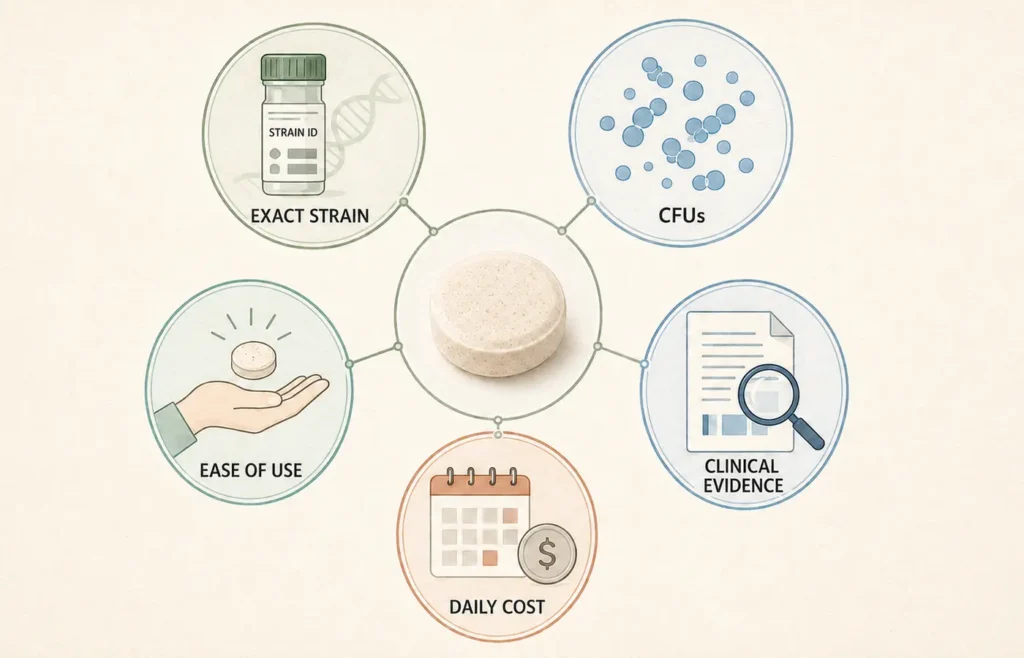
We did not rank the products by testimonial count, marketing language or the number of stars displayed by an online retailer.
The comparison considers six factors.
1. Strain identification
A bacterial species is not the same as a specific strain.
For example, research involving Streptococcus salivarius K12 cannot automatically support a product that lists only Streptococcus salivarius without identifying K12.
2. CFU disclosure
CFU means colony-forming units and represents viable microorganisms under the conditions used for the count.
We checked:
- Whether a CFU amount was disclosed.
- Whether the amount applied to one strain or a blend.
- Whether individual strain quantities were available.
- Whether the count was stated at manufacture or guaranteed through expiration.
3. Evidence for the exact strains
Research about a general species is weaker support than research involving the exact strain identified on the product label.
4. Evidence for the finished product
Even when individual strains have been studied, the finished commercial formula may use a different amount, combination, delivery method or supporting ingredients.
5. Daily cost
We calculated the approximate cost using current official prices and the minimum reviewed daily serving.
6. Practical use
We considered:
- Number of tablets or lozenges.
- Storage instructions.
- Allergens.
- Sweeteners.
- Purchase format.
- Whether the product is positioned for breath, gums or general oral wellness.
No company supplied products, payment or editorial approval for this comparison.
ProDentim formula: What does it contain?
The archived ProDentim label in the NIH Dietary Supplement Label Database lists the following dietary ingredients per soft tablet:
- Inulin powder: 100 mg.
- Proprietary probiotic blend: 20 mg and 3.5 billion CFU.
- Lactobacillus paracasei.
- Lactobacillus reuteri.
- Bifidobacterium lactis BL-04.
- Streptococcus salivarius: 20 mg, listed separately without a CFU amount.
Other listed ingredients include tricalcium phosphate, microcrystalline cellulose, natural strawberry flavor and peppermint essential oil.
What is positive about the ProDentim formula?
ProDentim combines:
- More than one probiotic species.
- A prebiotic ingredient.
- A dissolvable oral delivery format.
- A relatively high total disclosed CFU count.
- One daily serving.
- A specifically identified B. lactis BL-04 strain.
The local delivery format is reasonable for a product intended to interact with the mouth.
What is missing from the ProDentim label?
The label does not identify strain codes for:
- L. paracasei.
- L. reuteri.
- S. salivarius.
It also does not state how the 3.5 billion CFU are divided among the three microorganisms in the proprietary blend.
The separately listed S. salivarius is expressed in milligrams rather than CFUs.
This prevents readers from determining:
- Whether the L. reuteri is the same strain used in a particular periodontal trial.
- Whether the S. salivarius is K12, M18 or another strain.
- How much of each microorganism is supplied.
- Whether every strain is present in a clinically studied amount.
Does the ProDentim website match the label?
Not completely.
The current official ProDentim presentation emphasizes three probiotic ingredients:
- L. paracasei.
- L. reuteri.
- B. lactis BL-04.
It does not clearly present the separately listed S. salivarius found on the archived label.
The website also discusses malic acid, while malic acid does not appear on the archived Supplement Facts or other-ingredients list we reviewed.
This does not prove that the product is unsafe or counterfeit. Formulas and marketing pages can change.
However, the discrepancy makes it especially important to review the current physical label rather than relying only on the sales presentation.
Our complete ProDentim ingredients guide examines these differences in greater detail.
Has the complete ProDentim formula been clinically studied?
We could not identify a peer-reviewed clinical trial evaluating the complete marketed ProDentim formula.
Individual species or strains have been studied in other products, but those studies do not prove that ProDentim produces the same outcomes.
That is the product’s largest evidence limitation.
BioGaia Prodentis formula and evidence
The current BioGaia Prodentis product page lists two exact strains:
- Limosilactobacillus reuteri DSM 17938.
- Limosilactobacillus reuteri ATCC PTA 5289.
Older research may refer to these microorganisms as Lactobacillus reuteri. The naming difference reflects a taxonomic update rather than a different strain.
The official Canadian specification lists 200 million CFU of the dual-strain combination per lozenge.
The current U.S. product is priced at $19.99 for 30 lozenges and recommends one lozenge daily, preferably after brushing.
Why does the strain identification matter?
DSM 17938 and ATCC PTA 5289 have been evaluated together in multiple oral-health trials.
A preliminary randomized trial involving 30 people with chronic periodontitis reported improved clinical and microbiological outcomes when the dual-strain lozenges were used with scaling and root planing.
However, not every trial has been positive.
A 2019 randomized periodontal trial enrolled 59 participants and found no statistically significant additional clinical benefit between the probiotic and placebo groups after non-surgical periodontal treatment.
A 2021 pilot trial involving 27 adolescents reported improvements in plaque, gingivitis and bleeding indices, but the differences did not reach statistical significance.
Other periodontal trials have reported advantages for selected outcomes, particularly when the lozenges were used as an adjunct to professional treatment.
Does this prove that BioGaia Prodentis treats gum disease?
No.
The evidence is mixed, study populations differ and many trials combine probiotics with:
- Scaling and root planing.
- Professional periodontal monitoring.
- Established oral hygiene.
- Other clinical interventions.
The findings cannot be converted into a claim that one daily retail lozenge independently treats periodontitis.
How does BioGaia compare with ProDentim?
BioGaia supplies fewer disclosed CFUs but provides much greater strain precision.
It also has a closer connection between the marketed strain combination and published human studies.
Compared with ProDentim, BioGaia is:
- Less expensive per 30-day supply.
- More transparent at the strain level.
- Supported by more direct human research.
- Simpler in formulation.
- Available through more conventional retail channels.
ProDentim provides a broader blend and a higher total CFU count.
Whether a broader blend is preferable has not been established.
NOW OralBiotic formula and evidence
NOW OralBiotic contains:
- Streptococcus salivarius BLIS K12.
- 1 billion CFU per two-lozenge serving at the time of manufacture.
- Fructooligosaccharides.
- Xylitol.
- Sorbitol.
- Natural strawberry flavor.
The strain is identity-verified, and the product is described as vegan, dairy-free and gluten-free.
The label directs adults to take two lozenges one to four times daily.
The bottle contains 60 lozenges, so it lasts:
- 30 days at two lozenges daily.
- 15 days at four lozenges daily.
- 10 days at six lozenges daily.
- Approximately 7.5 days at eight lozenges daily.
It must be refrigerated after opening.
What has BLIS K12 been studied for?
K12 has been researched mainly in relation to:
- Oral malodor.
- Tongue-coating bacteria.
- Throat health.
- Ear, nose and throat outcomes.
- Oral microbial colonization.
A 2020 double-blind randomized trial involved 28 people with tongue-coating-associated halitosis.
The K12 group improved compared with its own baseline for selected breath measurements. However, the more complete analysis did not find statistically significant differences between the K12 and placebo groups.
The researchers concluded that K12 did not significantly improve this form of halitosis when the tongue coating was not physically or chemically treated first.
Earlier studies involving antimicrobial pretreatment reported more promising results, but they do not establish that K12 alone will resolve persistent bad breath.
Is NOW OralBiotic better for bad breath than ProDentim?
Its label provides a stronger evidence connection for this specific goal because it identifies K12.
ProDentim lists S. salivarius but does not identify it as K12 or another breath-focused strain.
That does not prove that NOW OralBiotic will work better for every user.
Bad breath can be caused by:
- Tongue coating.
- Gum disease.
- Cavities.
- Dry mouth.
- Smoking.
- Diet.
- Tonsil stones.
- Sinus conditions.
- Reflux.
- Medication.
- Other medical concerns.
A supplement cannot replace identifying and treating the actual cause.
FLORASSIST Oral Hygiene formula and evidence
Life Extension FLORASSIST Probiotic Oral Hygiene contains:
- 2.5 billion CFU of Streptococcus salivarius BLIS M18.
- 50 mg of heat-treated Lactobacillus plantarum L-137, marketed as Immuno-LP20.
- Xylitol.
- Mannitol.
- Spearmint and cherry flavors.
The product costs $18 as a one-time purchase or $16 through the current AutoShip program.
One bottle contains 30 lozenges, and the label recommends one lozenge daily, preferably after brushing.
The product contains milk.
What is a postbiotic?
The L. plantarum L-137 ingredient is heat-treated.
It is therefore not a live probiotic measured through CFUs in the same way as M18.
A postbiotic may contain inactivated microorganisms or their components. It should not be added to the M18 CFU number as if both ingredients represented live bacteria.
What has BLIS M18 been studied for?
M18 has been evaluated in relation to:
- Dental plaque.
- Gingival indices.
- Bleeding on probing.
- Salivary bacteria.
- Caries-risk markers.
- Periodontal outcomes.
A 2023 randomized trial involving young adults reported improvements in gingival and plaque measurements after 28 days of M18 supplementation.
A 2024 randomized trial evaluated three months of M18 supplementation and reported reductions in gingival bleeding and plaque accumulation.
A 2025 randomized trial evaluated M18 as an adjunct to non-surgical periodontal treatment and reported improvements in selected periodontal outcomes.
An earlier randomized trial involving children reported lower plaque scores after three months, particularly among participants with higher initial plaque levels. The study did not prove that M18 healed cavities.
Has the complete FLORASSIST formula been clinically tested?
The company connects the M18 and postbiotic components to separate studies.
We could not identify an independent randomized clinical trial establishing that the current combined FLORASSIST formula produces every outcome presented on the product page.
The M18 strain has human research, but strain-specific evidence is not identical to finished-product evidence.
Which product has the best clinical evidence?

BioGaia Prodentis has the closest connection between:
- The exact strains named on the label.
- The dual-strain combination used in studies.
- The lozenge delivery format.
- Published periodontal research.
The evidence is not uniformly positive, but the product-to-research connection is clearer than it is for ProDentim.
FLORASSIST provides a transparent M18 dose and a growing collection of positive human trials involving that strain.
NOW OralBiotic provides a precise K12 dose, but its most relevant breath evidence is limited and mixed.
ProDentim contains ingredients that have been studied individually. However, unspecified strain identities and the absence of a finished-formula trial make direct extrapolation more difficult.
| Product | Exact strain disclosure | Relevant human strain research | Finished-formula evidence |
|---|---|---|---|
| ProDentim | Partial | Yes, for selected ingredients or related strains | No published trial identified |
| BioGaia Prodentis | Strong | Multiple studies using the exact dual-strain combination | Closest match, although study protocols and retail directions can differ |
| NOW OralBiotic | Strong for K12 | Several K12 studies | No trial of the complete NOW formula identified |
| FLORASSIST | Strong for M18 and L-137 | Multiple M18 studies and separate L-137 research | No trial of the complete current combination identified |
Does ProDentim have more CFUs?
ProDentim discloses 3.5 billion CFU for its three-strain proprietary blend.
This is higher than:
- The 200 million CFU listed for BioGaia Prodentis.
- The 1 billion CFU per minimum NOW OralBiotic serving.
- The 2.5 billion CFU of M18 in FLORASSIST.
However, the comparison is not as simple as 3.5 billion versus 200 million.
The NIH Office of Dietary Supplements states that products with higher CFU counts are not necessarily more effective than products with lower counts.
A meaningful evaluation also requires:
- Exact strain identity.
- Clinically relevant dose.
- Delivery method.
- Storage conditions.
- Viability throughout shelf life.
- Intended outcome.
- Duration of use.
- Evidence for that strain and population.
A lower-CFU product using a precisely studied strain could have a stronger evidence connection than a higher-CFU proprietary blend.
What does “CFU at the time of manufacture” mean?
A count stated at manufacture describes the number of viable organisms measured or expected when the product was produced.
It does not necessarily guarantee the same number on the final day before expiration.
Live microorganism counts may decline because of:
- Time.
- Heat.
- Humidity.
- Oxygen.
- Packaging.
- Storage after opening.
- Transportation conditions.
A stronger label would clearly state whether the declared CFU amount is guaranteed through the expiration date.
The current NOW OralBiotic label explicitly qualifies its 1 billion CFU figure as applying at the time of manufacture.
The archived ProDentim label also uses an at-manufacture qualification.
Are more probiotic strains automatically better?
No.
A four-microorganism formula is not automatically more effective than a one- or two-strain product.
Adding more microorganisms can create questions about:
- The amount assigned to each strain.
- Whether all strains remain viable together.
- Whether the combination has been tested.
- Whether one strain changes the activity of another.
- Whether the product matches the intended outcome.
- Whether the combined dose is appropriate.
A broad formula may be attractive to consumers seeking general oral-wellness support.
A targeted exact-strain formula may be easier to evaluate scientifically.
Neither approach guarantees results.
ProDentim price versus other oral probiotics

The following comparison uses prices displayed by the official product pages during our July 29, 2026 review.
| Product and package | Total product price | Estimated supply | Approximate daily cost |
|---|---|---|---|
| ProDentim one bottle | $69 | 30 days | $2.30 |
| ProDentim three bottles | $177 | 90 days | $1.97 |
| ProDentim six bottles | $294 | 180 days | $1.63 |
| BioGaia Prodentis | $19.99 | 30 days | $0.67 |
| NOW OralBiotic sale price | $20.79 | 30 days at minimum adult use | $0.69 |
| NOW OralBiotic regular price | $25.99 | 30 days at minimum adult use | $0.87 |
| FLORASSIST one-time purchase | $18 | 30 days | $0.60 |
| FLORASSIST AutoShip | $16 | 30 days | $0.53 |
ProDentim costs approximately 2.5 to almost four times as much per 30-day supply as the other once-daily options reviewed.
The ProDentim six-bottle package reduces the monthly average, but it requires a $294 upfront purchase.
The price difference is not explained by published evidence showing that ProDentim works two to four times better.
Is the ProDentim six-bottle package a better value?
It provides the lowest ProDentim cost per bottle.
It does not necessarily provide the best overall value.
Before purchasing six bottles, consider:
- Whether the formula suits your goal.
- Whether the ingredients are appropriate for you.
- Whether you have tried an oral probiotic before.
- The absence of a ProDentim finished-formula trial.
- The total upfront cost.
- The refund deadline.
- The requirement to return bottles.
- Return shipping costs.
- Whether a lower-cost exact-strain alternative better matches your goal.
Our guide to where to buy ProDentim safely explains its current packages, shipping and return requirements.
Which oral probiotic is best for gum health?
No oral probiotic should be treated as an independent treatment for gingivitis or periodontitis.
Within this comparison, BioGaia’s dual L. reuteri strains have the longest and most directly connected periodontal research history.
M18 also has increasingly relevant human evidence involving:
- Plaque.
- Gingival indices.
- Bleeding.
- Periodontal outcomes alongside professional treatment.
ProDentim includes L. reuteri and other microorganisms, but the strain identity and individual doses are not available.
For someone specifically comparing labels and evidence for a gum-related goal, BioGaia Prodentis or an identified M18 product provides a clearer evidence trail than ProDentim.
This does not mean either product can replace:
- Dental examination.
- Professional cleaning.
- Scaling and root planing.
- Treatment of infection.
- Brushing with fluoride toothpaste.
- Interdental cleaning.
- An individualized periodontal maintenance plan.
Which oral probiotic is best for bad breath?
NOW OralBiotic provides the most clearly breath-oriented exact strain in this comparison because it contains BLIS K12.
However, K12 trials have not produced uniformly positive results.
ProDentim does not disclose whether its S. salivarius is K12.
BioGaia Prodentis is marketed for fresh breath, but its core strains are the two L. reuteri strains rather than K12. BioGaia also sells a separate Fresh Breath formulation with zinc, which should not be confused with the standard product compared here.
Temporary freshness can also result from:
- Peppermint.
- Strawberry flavor.
- Increased saliva.
- Xylitol.
- The physical action of dissolving a lozenge.
That immediate sensation is not proof of a lasting microbial or clinical change.
Persistent halitosis requires evaluation of its cause.
Which product is best for plaque?
M18 has a relatively direct research connection with plaque-related outcomes.
BioGaia’s L. reuteri combination has also been evaluated for plaque and gingival indices, with mixed results across trials.
No evidence shows that ProDentim, FLORASSIST, NOW OralBiotic or BioGaia Prodentis can replace mechanical plaque removal.
Plaque is a biofilm that still requires established oral hygiene and, when necessary, professional cleaning.
Which oral probiotic is best for cavities?
None of the products has been proven to heal an existing cavity.
Some M18 studies have evaluated plaque, S. mutans and caries-risk markers. This does not demonstrate repair of cavitated tooth structure.
ProDentim’s sales materials discuss tooth support, but there is no finished-product clinical trial showing that it:
- Reverses an established cavity.
- Rebuilds missing enamel.
- Eliminates the need for a filling.
- Prevents every future cavity.
- Replaces fluoride.
A suspected cavity should be evaluated by a dental professional.
Which product is easiest to use?
ProDentim
- One soft tablet daily.
- No refrigeration instruction identified in the reviewed materials.
- Online purchase through the authorized sales funnel.
- Strawberry and peppermint flavoring.
BioGaia Prodentis
- One lozenge daily on the current U.S. page.
- Preferably used after brushing.
- Available through the company and conventional retail channels.
- Mint and apple variations may be available.
NOW OralBiotic
- At least two lozenges daily for adults.
- The label allows up to four servings daily.
- Must be refrigerated after opening.
- Strawberry flavor.
FLORASSIST
- One lozenge daily.
- Preferably used after brushing.
- Mint and cherry flavoring.
- Available as a one-time purchase or subscription.
- Contains milk.
For a simple once-daily routine, ProDentim, BioGaia and FLORASSIST are more straightforward than the variable NOW dosage.
What about allergens, sweeteners and storage?
The supporting ingredients may matter as much as the probiotic count for some users.
ProDentim
Review the current physical label for flavoring ingredients, sensitivities and any formula updates.
BioGaia Prodentis
The reviewed U.S. formula includes isomalt and xylitol. Regional variations can contain different flavors or supporting ingredients.
NOW OralBiotic
The product contains:
- Xylitol.
- Sorbitol.
- Fructooligosaccharides.
- Strawberry flavor.
The manufacturer states that it is vegan and free from several common allergens. It requires refrigeration after opening.
FLORASSIST
The product contains:
- Xylitol.
- Mannitol.
- Spearmint flavor.
- Cherry flavor.
- Milk.
Products containing xylitol should be kept away from dogs and other pets because xylitol can be highly toxic to them.
Sugar alcohols can also cause digestive discomfort in some people, particularly at larger amounts.
Can you take ProDentim with another oral probiotic?
There is no reliable evidence that combining ProDentim with K12, M18 or BioGaia Prodentis produces better results.
Combining products could increase:
- Cost.
- Total sweetener intake.
- Exposure to more ingredients.
- Risk of digestive discomfort.
- Difficulty identifying which product caused a benefit or reaction.
- Complexity of the routine.
More microorganisms do not automatically produce a better oral ecosystem.
People taking medication, managing a significant medical condition or considering multiple supplements should discuss the combination with an appropriate healthcare professional.
Are any of these products FDA approved?
No oral probiotic in this comparison should be described as FDA approved for treating dental disease.
A manufacturer may operate under applicable production requirements, but this is not the same as FDA approval of:
- The finished product.
- Its clinical effectiveness.
- Its label.
- Its marketing claims.
- Its ability to treat a disease.
Any seller promising an FDA-approved probiotic cure for cavities or gum disease should be treated cautiously.
Which oral probiotic offers the best value?
BioGaia Prodentis offers the strongest overall evidence-to-price alignment in this four-product comparison.
It combines:
- Exact strain identification.
- Multiple human trials using the dual-strain preparation.
- A simple once-daily retail direction.
- A current price below $20 for 30 lozenges.
FLORASSIST is also competitively priced and provides a clearly disclosed M18 dose, making it a relevant alternative for consumers prioritizing M18 research.
NOW OralBiotic offers an exact K12 strain at a reasonable minimum monthly cost, but the dosage range can substantially increase the cost.
ProDentim offers:
- More named microorganisms.
- A higher combined CFU count.
- A prebiotic ingredient.
- One daily serving.
- A broad oral-wellness positioning.
Its disadvantages include:
- The highest monthly price.
- Limited strain-level disclosure.
- No disclosed amount for each microorganism.
- Differences between the archived label and marketing presentation.
- No published trial of the complete formula.
Value depends on the outcome being pursued, but the available evidence does not establish that ProDentim’s price premium produces a superior clinical benefit.
Is ProDentim worth buying instead of another oral probiotic?
ProDentim may appeal to someone who:
- Prefers a broad multi-species formula.
- Wants a once-daily soft tablet.
- Values the combination of probiotics and inulin.
- Accepts the higher price.
- Understands the absence of product-specific clinical evidence.
- Has reviewed the current label and refund terms.
- Is not expecting the supplement to treat dental disease.
A more targeted alternative may be preferable for someone who:
- Wants exact strain codes.
- Is selecting a product based on a specific study.
- Prioritizes lower monthly cost.
- Wants conventional retail availability.
- Prefers a formula focused on K12, M18 or the BioGaia dual-strain combination.
ProDentim is not automatically a poor product because another option is less expensive.
It is also not automatically superior because it lists more CFUs and more microorganisms.
Frequently asked questions
Is ProDentim the same as BioGaia Prodentis?
No.
They are separate products from different companies. BioGaia Prodentis uses two identified L. reuteri strains, while ProDentim uses a broader proprietary formula.
Which has more CFUs, ProDentim or BioGaia Prodentis?
ProDentim discloses 3.5 billion CFU for its three-strain proprietary blend.
BioGaia regional specifications list 200 million CFU per Prodentis lozenge.
The higher ProDentim number does not prove that it is more effective.
Which has more CFUs, ProDentim or FLORASSIST?
ProDentim lists 3.5 billion CFU for its three-strain blend.
FLORASSIST lists 2.5 billion CFU of the exact M18 strain.
FLORASSIST also contains a heat-treated postbiotic that is not counted as live CFUs.
Does ProDentim contain BLIS K12?
The archived label lists Streptococcus salivarius but does not identify it as K12.
K12 research should not be attributed to ProDentim without confirmation of the strain.
Does ProDentim contain BLIS M18?
The label does not identify its S. salivarius as M18.
M18 studies do not directly establish ProDentim’s effectiveness.
Which oral probiotic has the best clinical evidence?
BioGaia Prodentis has the closest connection between its exact commercial strain combination and multiple oral-health trials.
The evidence is still mixed, and no product has been proven best through a direct head-to-head trial.
Is BioGaia Prodentis better than ProDentim for gums?
BioGaia provides a clearer strain-to-study connection for periodontal outcomes.
This does not prove that it treats gum disease or that every user will benefit. Most relevant studies used the probiotic alongside established dental care.
Is BLIS K12 better for bad breath?
K12 is more directly associated with halitosis research than ProDentim’s unspecified S. salivarius.
However, clinical results are mixed, and persistent bad breath requires investigation of its underlying cause.
Is BLIS M18 better for plaque?
M18 has several trials involving plaque and gingival indices.
It has not been proven to replace brushing, interdental cleaning or professional plaque removal.
What is the cheapest ProDentim alternative?
Among the official prices reviewed, FLORASSIST was $18 for a 30-day one-time purchase.
BioGaia Prodentis was $19.99 for 30 lozenges, and NOW OralBiotic was $20.79 at its temporary sale price.
Why is ProDentim more expensive?
ProDentim is sold through a direct-response online sales funnel and offers a broader blend, package discounts, digital bonuses and a refund policy.
These commercial differences do not prove greater clinical effectiveness.
Are more probiotic strains better for oral health?
Not necessarily.
Exact strain identity, clinically relevant dose, delivery method and evidence for the intended outcome are more useful than strain count alone.
Can I take ProDentim and BioGaia Prodentis together?
No research shows that the combination is more effective.
Combining products increases cost and ingredient exposure. Professional guidance is appropriate when there are medical conditions, medications or ongoing dental concerns.
Can any oral probiotic heal a cavity?
No reliable evidence shows that these products heal an existing cavity.
A cavity should be professionally evaluated.
Can oral probiotics reverse gum disease?
They should not be expected to reverse gum disease independently.
Selected strains have been studied as adjuncts to professional periodontal treatment, not as replacements for it.
Are oral probiotics FDA approved?
Dietary supplements are not FDA approved for effectiveness before being sold.
None of these products should be represented as an FDA-approved treatment for dental disease.
How long should I test an oral probiotic?
There is no universal clinically validated trial period for consumers.
A practical evaluation should use:
- One clearly defined goal.
- Consistent oral hygiene.
- The current label directions.
- Regular observations.
- Professional measurements when the goal involves gums, plaque or disease.
Our guide to how long ProDentim may take to work explains why study periods should not be converted into guaranteed timelines.
Final verdict: ProDentim versus other oral probiotics
No evidence proves that ProDentim is the best oral probiotic.
It has the highest disclosed live count in this comparison and the broadest combination of named probiotic species. It also includes an inulin prebiotic and uses a convenient once-daily oral format.
Those advantages are offset by:
- Limited exact-strain disclosure.
- No per-strain CFU amounts.
- No CFU amount for the separate S. salivarius ingredient.
- Differences between the archived label and current marketing presentation.
- No published clinical trial of the complete formula.
- A substantially higher monthly price.
BioGaia Prodentis provides the clearest connection between its exact strains and published oral-health trials. Although the evidence is mixed and does not establish it as a treatment, its strain transparency and lower price create a stronger evidence-to-value profile.
NOW OralBiotic is a more targeted K12 option for someone specifically evaluating breath-related research. FLORASSIST provides a transparent M18 dose and a growing body of plaque and gingival research at a lower monthly cost.
The practical comparison is:
- Choose ProDentim if you specifically want its broader formula and accept the higher price and evidence limitations.
- Consider BioGaia Prodentis if strain identification and the closest connection with periodontal studies are priorities.
- Consider a K12 product if the main interest is breath-related evidence.
- Consider an M18 product if the main interest is plaque and gingival research.
- See a dentist when the concern involves pain, swelling, cavities, persistent bleeding, recession, infection, loose teeth or continuing bad breath.
No oral probiotic replaces brushing with fluoride toothpaste, interdental cleaning, professional diagnosis or necessary treatment.
For a complete evaluation of the product itself, read our full ProDentim review.
If you understand the comparison and still prefer the broader ProDentim formula, you can view the current ProDentim offer.
Medical disclaimer: This article is provided for general informational purposes only and does not replace advice, diagnosis or treatment from a qualified dental or healthcare professional.
Sources
- Official ProDentim Text Presentation
- NIH Dietary Supplement Label Database: ProDentim
- Official BioGaia Prodentis Product Page
- BioGaia Prodentis Canadian Product Specification
- Official NOW OralBiotic Product Page
- Official FLORASSIST Oral Hygiene Product Page
- NIH Office of Dietary Supplements: Probiotics
- FDA: Questions and Answers on Dietary Supplements
- Effect of L. reuteri Prodentis in Periodontal Disease
- Randomized L. reuteri Periodontal Trial
- L. reuteri DSM 17938 and ATCC PTA 5289 Pilot Trial
- Effect of S. salivarius K12 on Halitosis
- Antigingivitis and Antiplaque Effects of S. salivarius M18
- Three-Month S. salivarius M18 Trial
- M18 as an Adjunct in Periodontitis Treatment
- M18 and Dental Health Indices in Children
- American Dental Association: Home Oral Care