
Affiliate disclosure: This article may contain affiliate links. If you purchase through our links, Only For U Deals may earn a commission at no additional cost to you.
Does ProDentim work? The most accurate answer is more nuanced than a simple yes or no.
ProDentim contains probiotic microorganisms related to a growing area of oral health research. Some studies involving oral probiotics have reported improvements in measurements associated with gum health, bad breath and certain oral bacteria.
However, research involving a particular probiotic strain does not automatically prove that a commercial supplement containing the same species will produce identical results.
The most important limitation is that we could not identify a published peer-reviewed clinical trial evaluating the complete ProDentim formula as a finished product during our latest search, updated on July 29, 2026.
That does not prove that ProDentim cannot provide benefits. It means its effectiveness has not been established to the same standard as a finished product tested against a placebo in a well-designed clinical trial.
Quick answer: Does ProDentim really work?
ProDentim may help some users support breath freshness, gum comfort or a balanced oral environment when used consistently alongside established oral hygiene. Its ingredients have a scientifically plausible connection to oral health, and research involving specific probiotic strains provides some encouraging findings.
However:
- The finished ProDentim formula has not been clinically proven in a published randomized controlled trial that we could identify.
- Studies involving individual strains are not direct studies of ProDentim.
- The formula should not be expected to cure cavities, reverse gum disease or repair damaged teeth.
- Testimonials cannot establish how frequently the product works.
- Individual ProDentim results can vary.
- It should complement brushing, interdental cleaning and professional dental care rather than replace them.
The fairest conclusion is that ProDentim is a plausible oral probiotic supplement with relevant ingredient-level research, but limited direct product-level evidence.
What would count as evidence that ProDentim works?
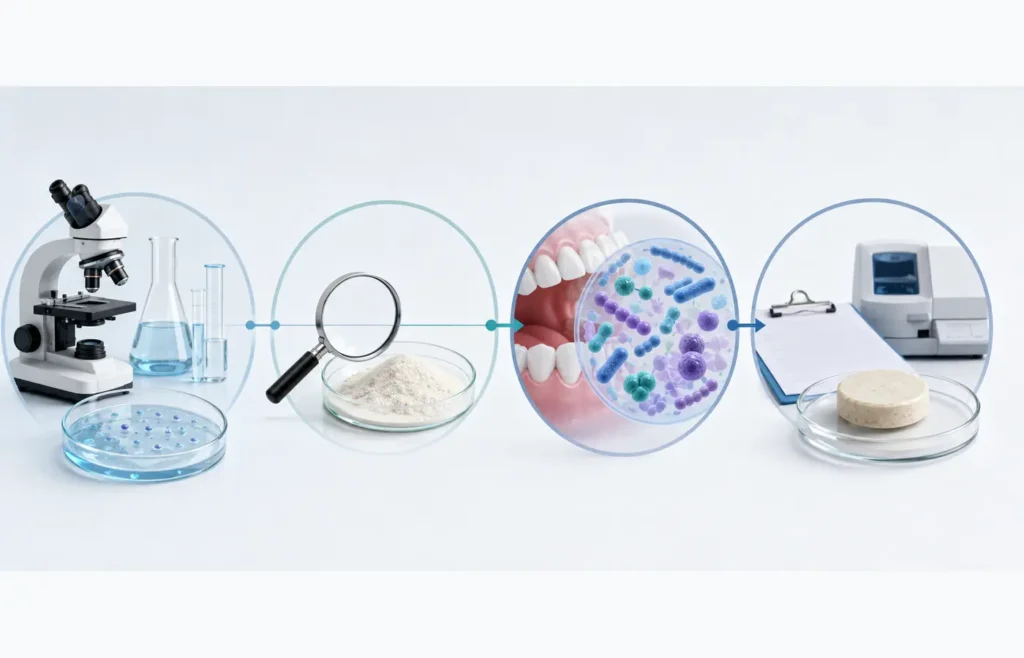
Not every type of evidence answers the same question.
A laboratory study can show that a microorganism interacts with certain bacteria. A clinical study can investigate whether people experience measurable improvements. A trial of the complete commercial formula can show whether that particular combination performs better than a placebo.
These levels should not be treated as interchangeable.
| Type of evidence | What it can show | Main limitation |
|---|---|---|
| Laboratory research | A possible biological mechanism or interaction between microorganisms | Laboratory conditions do not reproduce the complete human mouth |
| Research on an individual strain | Whether a specific strain may affect a particular outcome | The dose, strain and delivery method may differ from ProDentim |
| Research on oral probiotics as a category | Whether selected probiotics may be useful in certain situations | Results cannot be generalized to every oral probiotic |
| Trial of the complete ProDentim formula | Whether the finished product outperforms a placebo under defined conditions | We could not identify this type of published trial |
| Customer testimonials | What individual customers say they experienced | They cannot establish cause, frequency or effectiveness |
When marketing states that a product contains researched ingredients, that is not the same as demonstrating that the finished commercial formula has been clinically proven.
Has ProDentim itself been clinically tested?
During our latest review, we searched scientific literature and clinical trial resources using the ProDentim product name.
We did not identify a peer-reviewed randomized controlled trial evaluating the finished ProDentim formula in PubMed or a ProDentim-named interventional study registered in ClinicalTrials.gov.
This distinction matters because a finished product combines:
- Multiple probiotic microorganisms.
- A particular total CFU count.
- Specific amounts of each ingredient.
- A dissolvable tablet format.
- Manufacturing and storage conditions.
- Directions for use.
- Additional active and inactive ingredients.
Even when individual components have been studied, the complete combination may behave differently.
A product-level trial would ideally identify the exact formula, confirm microorganism viability, compare ProDentim with a placebo and use objective outcomes such as plaque measurements, bleeding on probing, gum indices or volatile sulfur compounds associated with bad breath.
Without that type of study, no responsible reviewer can calculate how likely ProDentim is to work or how large its average effect might be.
What does the ProDentim label confirm?
The ProDentim entry in the NIH Dietary Supplement Label Database records a serving size of one soft tablet.
The archived Supplement Facts panel lists:
- Inulin powder.
- A proprietary probiotic blend providing 3.5 billion CFU.
- Lactobacillus paracasei.
- Lactobacillus reuteri.
- Bifidobacterium animalis subsp. lactis BL-04.
- Streptococcus salivarius as a separately listed ingredient.
The proprietary blend does not disclose how the 3.5 billion CFU are divided among the microorganisms. Complete strain designations are also not provided for every organism.
Because probiotic effects can be strain-specific, knowing only the species does not always allow researchers to connect the formula to a particular clinical trial.
The NIH label database is a useful source for examining recorded packaging information. However, inclusion in the database does not mean that NIH tested, approved or endorsed ProDentim.
Consumers should compare the archived information with the actual bottle they receive because formulas, labels and directions can change. Our complete ProDentim ingredients guide examines the recorded formula in more detail.
Is ProDentim FDA approved?
No dietary supplement should be described as FDA approved for effectiveness in the same way as an approved medication.
The FDA explains that dietary supplements are not approved for safety and effectiveness before they are marketed. Companies are responsible for ensuring that their products comply with applicable safety, manufacturing and labeling requirements.
The FDA can inspect facilities, investigate complaints and take action against products that violate the law. That regulatory oversight is not the same as premarket approval of ProDentim’s effectiveness.
Registration of a facility, manufacture under quality standards or the presence of a Supplement Facts panel should not be presented as proof that a product works.
The FDA also states that a dietary supplement cannot legally be marketed as a product intended to diagnose, treat, cure or prevent a specific disease.
ProDentim should therefore be evaluated as a dietary supplement intended to support oral wellness, not as an approved treatment for cavities, gingivitis, periodontitis or another dental disease.
How is ProDentim supposed to work?
ProDentim is based on the idea that introducing selected microorganisms into the mouth may help support a more favorable oral microbial environment.
The mouth naturally contains a complex community of microorganisms. Oral health does not require eliminating every bacterium. Instead, researchers study how microbial balance, dental plaque, saliva, diet, hygiene and the immune response interact.
Possible probiotic mechanisms include:
- Competing with less desirable microorganisms for nutrients or attachment sites.
- Producing substances that influence other microorganisms.
- Affecting biofilm formation.
- Interacting with inflammatory responses.
- Temporarily changing the composition of saliva or dental plaque.
These mechanisms are scientifically plausible, but plausibility alone does not confirm a meaningful clinical benefit.
A probiotic must also remain viable, be delivered in an appropriate amount and interact with the intended area for sufficient time. Even then, the effect can depend on the strain and the individual user.
Our broader guide to oral probiotics for teeth and gums examines the research behind this category without assuming that every finding applies directly to ProDentim.
What do studies involving ProDentim’s probiotic species show?

The formula includes microorganisms connected to oral probiotic research. The critical question is how closely those studies match the strains and delivery method present in ProDentim.
Lactobacillus reuteri
Lactobacillus reuteri is one of the more frequently studied probiotic species in periodontal research.
A 2024 systematic review and network meta-analysis examined 33 articles involving 1,290 patients. The researchers found that some probiotic interventions used alongside professional mechanical plaque removal were associated with improvements in periodontal measurements.
Lactobacillus interventions produced some of the most substantial findings in the analysis.
However, the probiotics were generally studied as additions to professional periodontal care. These findings do not demonstrate that ProDentim can independently treat periodontitis.
An earlier randomized placebo-controlled trial involving Lactobacillus reuteri lozenges also examined the probiotic as an adjunct to non-surgical periodontal treatment.
The trial involved particular L. reuteri strains, a defined research protocol and professional treatment. ProDentim’s archived label does not provide enough strain-level information to establish that its L. reuteri is identical to the strains used in that study.
Lactobacillus paracasei
Research involving Lactobacillus paracasei has examined outcomes related to mutans streptococci and dental cavities.
A randomized placebo-controlled trial involving L. paracasei SD1 reported a reduction in salivary mutans streptococci after short-term consumption.
A separate study involving preschool children found that milk powder containing the SD1 strain was associated with reduced salivary mutans streptococci and delayed development of new cavities.
These studies are relevant to the broader scientific discussion, but important differences remain:
- They evaluated the SD1 strain.
- The probiotic was delivered through milk powder.
- Some participants were children.
- The research did not evaluate the complete ProDentim formula.
ProDentim’s archived label identifies L. paracasei but does not state that the included microorganism is the SD1 strain.
The results should therefore not be presented as direct proof that ProDentim prevents cavities.
Bifidobacterium animalis subsp. lactis BL-04
BL-04 is a specific and established probiotic strain. Much of its published research has focused on immune, respiratory or gastrointestinal outcomes rather than direct clinical measurements involving teeth and gums.
Evidence that a strain has been studied in one area of health cannot automatically be transferred to another.
The presence of BL-04 may contribute to the formula’s general probiotic rationale, but stronger product-specific evidence would be needed to determine its role in ProDentim’s oral health results.
Streptococcus salivarius
Certain Streptococcus salivarius strains, particularly K12 and M18, have been studied in oral health research.
For example, a small clinical study involving S. salivarius K12 examined its effect on halitosis associated with tongue coating. Other research has examined the M18 strain in relation to oral bacteria and caries risk.
However, K12 and M18 are specific strains. The archived ProDentim label lists Streptococcus salivarius without identifying one of those complete strain designations.
It would therefore be inappropriate to assume that studies involving K12 or M18 prove the effectiveness of the S. salivarius included in ProDentim.
Why strain identification matters
A probiotic name can include several levels:
- Genus.
- Species.
- Subspecies, when applicable.
- Strain.
For example, identifying only Lactobacillus reuteri does not necessarily reveal the exact strain used.
The NIH Office of Dietary Supplements explains that commercial probiotics contain many combinations of strains and doses. It can be difficult to determine which products provide verifiable benefits because formulations and labeling practices vary.
The NIH also notes that a higher CFU count does not automatically make a probiotic more effective. The appropriate organism, strain, dose and intended outcome matter more than an impressive number alone.
This means that ProDentim’s 3.5 billion CFU total cannot by itself demonstrate effectiveness.
Can ProDentim improve gum health?
There is a reasonable scientific basis for studying selected probiotics as complements to periodontal care.
Research suggests that certain probiotic interventions may influence measurements such as:
- Bleeding on probing.
- Gingival inflammation.
- Periodontal pocket depth.
- Clinical attachment level.
- Counts of particular microorganisms.
However, these potential effects should not be translated into claims that ProDentim treats gum disease.
Bleeding, persistent swelling, gum recession, loose teeth and periodontal pockets require professional evaluation. Established periodontal treatment involves controlling plaque and calculus, improving daily hygiene and receiving individualized dental care.
ProDentim may be considered an optional addition to that foundation. It should not delay diagnosis or treatment.
Can ProDentim prevent cavities?
There is not enough product-specific evidence to conclude that ProDentim prevents cavities.
Some studies involving particular probiotic strains have reported changes in bacteria associated with dental caries. However, bacterial counts are surrogate measurements. A reduction in one microorganism does not always produce fewer cavities.
Cavity development is influenced by:
- Frequency of sugar exposure.
- Fluoride use.
- Saliva production.
- Oral hygiene.
- Dental anatomy.
- Existing restorations.
- Individual caries risk.
- Access to preventive dental care.
ProDentim should not replace fluoride toothpaste or professional preventive recommendations.
Claims that it can fill cavities, rebuild damaged teeth or eliminate the need for dental treatment are not supported by the evidence reviewed for this article.
Can ProDentim help with bad breath?
This may be one of the more plausible short-term outcomes for some users, but results are not guaranteed.
A systematic review of probiotics for halitosis reported possible short-term improvements involving selected probiotics. The included studies evaluated different microorganisms, protocols and methods for measuring breath.
Persistent bad breath can also result from:
- Tongue coating.
- Gum disease.
- Cavities.
- Dry mouth.
- Tobacco use.
- Diet.
- Certain medications.
- Tonsil stones.
- Medical conditions.
An improvement in perceived freshness does not prove that the underlying cause has been resolved.
Someone with persistent or unexplained bad breath should receive an appropriate dental or medical evaluation instead of relying exclusively on a supplement.
Can ProDentim make teeth stronger or whiter?
We could not identify direct clinical evidence showing that the finished ProDentim formula strengthens human tooth enamel or produces meaningful tooth whitening.
Ingredients such as tricalcium phosphate or malic acid may be connected to mechanisms discussed in dental or cosmetic research. However, an ingredient appearing in a tablet does not establish that the finished supplement delivers an effective concentration to the tooth surface.
Malic acid should not be treated as a substitute for professional whitening. Acidic substances can also affect enamel depending on their concentration, exposure and formulation.
People interested in whitening or enamel protection should rely on established dental products and individualized professional guidance.
What about ProDentim customer reviews?
Customer reviews can help identify recurring experiences involving:
- Flavor.
- Ease of use.
- Shipping.
- Customer service.
- Perceived breath freshness.
- Digestive tolerance.
- Satisfaction with the routine.
They cannot reliably determine whether ProDentim works.
Testimonials usually do not include:
- A placebo comparison.
- Objective dental measurements.
- Confirmation that the product caused the change.
- Complete health and hygiene information.
- A representative sample of every customer.
- Independent verification.
Positive reviews may reflect genuine individual experiences, placebo effects, simultaneous improvements in oral hygiene or natural changes over time.
Negative reviews are also individual reports and do not prove that the product fails for everyone.
Customer feedback should be treated as supplementary information, not clinical evidence.
Why might ProDentim results vary?
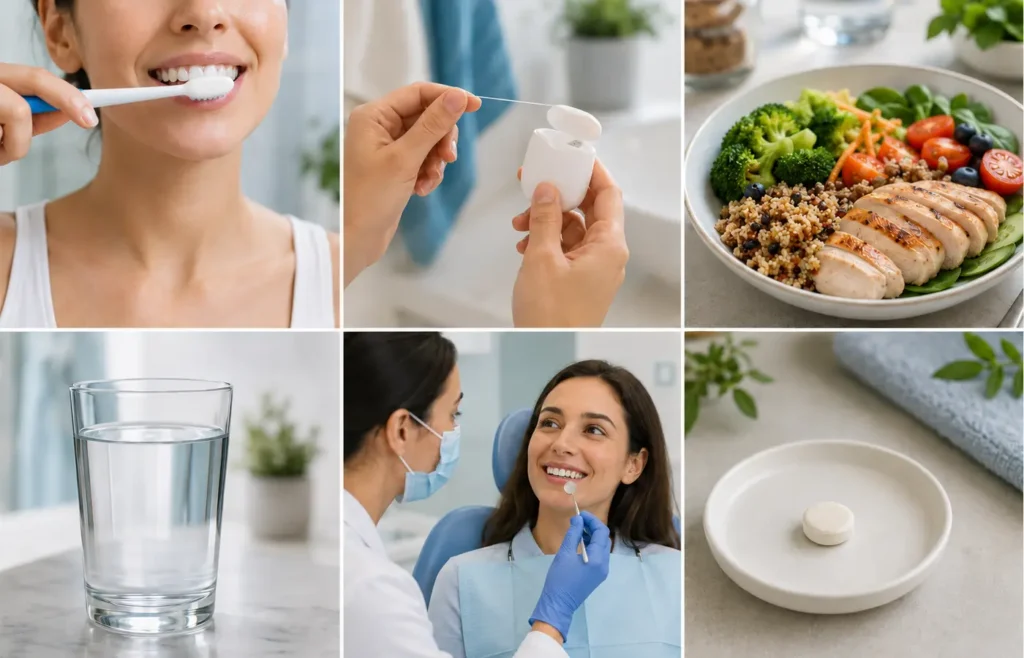
Even if a formula contains viable microorganisms, several factors can influence an individual response.
Existing oral health
Someone seeking general breath freshness is different from someone with untreated periodontitis, active cavities or severe dry mouth.
Daily oral hygiene
Changes in brushing, interdental cleaning and tongue cleaning can affect many of the same outcomes people attribute to an oral probiotic.
Diet and lifestyle
Sugar consumption, smoking, hydration and alcohol use influence the oral environment.
Saliva
Saliva affects microbial growth, acid neutralization and how substances move through the mouth.
Medications and health conditions
Antibiotics, dry-mouth medications, immune conditions and other health factors may influence probiotic use and oral symptoms.
Product viability
Probiotic microorganisms must remain viable through manufacturing, storage and the end of the product’s shelf life.
A laboratory analysis of 21 commercial oral probiotic products found substantial variation in microorganism characterization and viable cell counts.
The study did not evaluate ProDentim specifically. It demonstrates why the presence of a microorganism on a label does not automatically confirm product quality or clinical performance.
How can you evaluate your own ProDentim results?
An individual experience is not a clinical trial, but setting a specific goal can make personal evaluation more useful.
Before using the product, identify what you expect to change:
- Perceived breath freshness.
- Gum comfort.
- Oral dryness.
- Ease of maintaining the routine.
- Another realistic wellness outcome.
Avoid treating vague impressions as proof that the product has repaired dental disease.
If you decide to use ProDentim:
- Check the current label and expiration date.
- Follow the suggested serving.
- Keep brushing and interdental cleaning consistent.
- Avoid increasing the serving in search of faster results.
- Do not postpone dental care.
- Stop and seek guidance if you experience a concerning reaction.
- Reassess whether the perceived benefit justifies the ongoing cost.
Our guide explaining how to take ProDentim covers the archived directions and common usage mistakes.
Who should be cautious about trying ProDentim?
People who are pregnant, nursing, immunocompromised, taking medication or managing a significant health condition should discuss dietary supplements with an appropriate healthcare professional.
Probiotics are generally considered unlikely to cause harm in healthy people, but safety depends on the individual and the product.
Read the complete ingredient list carefully if you have allergies or sensitivities. Our guide to possible ProDentim side effects explains additional safety considerations.
Seek dental care for symptoms such as:
- Persistent tooth pain.
- Swelling.
- Pus or signs of infection.
- Bleeding that does not improve.
- Loose teeth.
- Gum recession.
- A broken tooth.
- Persistent bad breath without an obvious cause.
A supplement is not an appropriate substitute for diagnosing these problems.
Is ProDentim worth trying?
That depends on the standard being used.
ProDentim may be worth considering for someone who:
- Understands that it is a dietary supplement.
- Is interested in oral probiotics.
- Has realistic expectations.
- Will continue established oral care.
- Has reviewed the ingredients and warnings.
- Accepts that benefits are not guaranteed.
- Considers the cost reasonable.
It may not be a good choice for someone who expects it to:
- Cure gum disease.
- Repair cavities.
- Regrow lost gum tissue.
- Replace toothpaste or flossing.
- Produce guaranteed whitening.
- Eliminate the need for professional treatment.
- Provide medically proven results from the finished formula.
The decision should be based on the product’s actual label, the limits of the evidence, individual circumstances and the current purchase and refund conditions.
Our complete ProDentim review examines the formula, advantages, limitations, package options and purchasing considerations.
Frequently asked questions
Is ProDentim clinically proven?
We could not identify a published peer-reviewed clinical trial evaluating the complete ProDentim formula during our latest search.
Some of its probiotic species are connected to clinical research, but those studies often evaluate different strains, doses and delivery methods.
Does ProDentim really work for gums?
Selected probiotics have produced encouraging periodontal findings when used alongside professional care. This does not establish that ProDentim treats gum disease.
Some users may notice changes in gum comfort, but concerning or persistent symptoms require a dentist.
Does ProDentim work for bad breath?
It may support perceived breath freshness for some users. Research involving certain oral probiotic strains is promising, but persistent halitosis can have several causes that require investigation.
Can ProDentim remove plaque?
We found no direct clinical evidence showing how much plaque the complete ProDentim formula removes or prevents.
Mechanical brushing, interdental cleaning and professional care remain the established methods for plaque control.
Can ProDentim heal cavities?
No reliable evidence shows that ProDentim heals existing cavities. A cavity should be evaluated by a dental professional.
Can ProDentim regrow gums?
There is no credible clinical evidence that ProDentim regenerates lost gum tissue.
How quickly does ProDentim work?
There is no clinically established ProDentim results timeline. The finished formula has not been studied sufficiently to determine when an average user should notice a benefit.
Testimonials describing results within a particular number of days should not be interpreted as a guarantee.
Is ProDentim FDA approved?
No. The FDA does not approve dietary supplements for safety and effectiveness before they are marketed.
Does a high CFU count mean ProDentim is effective?
No. CFU count alone does not establish effectiveness. Probiotic results depend on the strain, dose, viability, formulation and intended outcome.
Does ProDentim replace brushing and flossing?
No. Continue your normal oral hygiene routine and follow professional dental recommendations.
Final verdict: Does ProDentim work?
ProDentim has a plausible concept and includes probiotic microorganisms related to oral health research.
The broader evidence suggests that selected probiotics may provide modest benefits in certain situations, especially when used as complements to conventional care. Research is more encouraging for some periodontal measurements and possible short-term improvements in bad breath than it is for claims involving cavity prevention, tooth repair or whitening.
However, the evidence has an important limitation: studies of individual probiotic strains and oral probiotics as a category do not prove that the complete ProDentim formula works.
As of our latest review, we could not identify a peer-reviewed clinical trial evaluating the finished product.
The most accurate conclusion is therefore:
ProDentim may provide supportive oral wellness benefits for some users, but its finished formula has not been clinically proven to deliver guaranteed results.
Treat it as an optional addition to oral care, not as a treatment for dental disease. Maintain realistic expectations, follow the current label and consult an appropriate professional when symptoms or personal health circumstances are relevant.
If you have reviewed the evidence and decided that ProDentim fits your expectations, you can view the current ProDentim offer on the official website.
Medical disclaimer: This article is provided for general informational purposes only and does not replace advice, diagnosis or treatment from a qualified dental or healthcare professional.
Sources
- NIH Dietary Supplement Label Database: ProDentim
- NIH Office of Dietary Supplements: Probiotics — Health Professional Fact Sheet
- FDA: Questions and Answers on Dietary Supplements
- FDA: Is It Really FDA Approved?
- Probiotics in the Non-Surgical Treatment of Periodontitis
- Clinical and Microbiological Effects of Lactobacillus reuteri Probiotics
- Lactobacillus paracasei SD1 Randomized Placebo-Controlled Trial
- Effect of Streptococcus salivarius K12 on Halitosis
- Efficacy of Probiotics in the Management of Halitosis
- Commercial Oral Probiotics: Do They Deliver What They Promise?