
Affiliate disclosure: This article contains affiliate links. If you purchase through our links, Only For U Deals may earn a commission at no additional cost to you.
Can ProDentim help bad breath?
It might temporarily make the mouth feel fresher, but there is no published clinical trial showing that ProDentim itself treats chronic halitosis.
The formula contains several microorganisms associated with oral-health research. However, most are not identified by exact strain code, and the archived label does not confirm that its Streptococcus salivarius is BLIS K12, BLIS M18 or another strain evaluated in bad-breath studies.
Research involving oral probiotics as a category is more encouraging than the evidence for ProDentim specifically. Recent systematic reviews suggest that selected probiotic strains may reduce odor scores or volatile sulfur compounds in some circumstances.
The results remain inconsistent, and the strongest findings often involve:
- An exact probiotic strain.
- Tongue cleaning or antimicrobial pretreatment.
- Professional periodontal care.
- Participants with a defined type of oral halitosis.
- Products and doses different from ProDentim.
Our assessment, updated on July 29, 2026, is that ProDentim should not be considered a proven treatment for halitosis.
It may be tested as an optional addition to established oral care after dental causes have been addressed, but it should not delay evaluation of persistent bad breath.
Quick verdict: Does ProDentim work for bad breath?
| Question | Evidence-based answer |
|---|---|
| Has ProDentim been clinically tested for halitosis? | No published finished-product trial was identified |
| Does it contain probiotics associated with oral health? | Yes, but most are not identified by exact strain |
| Does it contain BLIS K12? | The reviewed label does not confirm K12 |
| Could the tablet make the mouth feel fresher immediately? | Possibly, because of peppermint, flavoring, saliva stimulation and the dissolvable format |
| Does immediate freshness prove that halitosis improved? | No |
| Can general probiotic studies prove that ProDentim works? | No, because probiotic effects are strain-, dose- and product-specific |
| Can it treat gum disease, cavities or infection? | No |
| Should it replace brushing, interdental cleaning or tongue care? | No |
| Is it a guaranteed long-term solution? | No |
| Overall verdict | Biologically plausible, but not clinically established for bad breath |
The most important distinction is between temporary freshness and measurable control of halitosis.
A mint-flavored tablet can improve taste and perceived freshness for a limited period. A clinical effect would require evidence that it consistently reduces odor, volatile sulfur compounds or the underlying cause.
ProDentim has not demonstrated that level of evidence.
How did we evaluate ProDentim for halitosis?
We considered six separate questions.
1. Is the finished product clinically tested?
A study evaluating another probiotic does not prove that ProDentim produces the same effect.
The most direct evidence would be a randomized trial testing the complete ProDentim formula against placebo while measuring clinically relevant breath outcomes.
We could not identify such a trial.
2. Are the exact strains disclosed?
Probiotic effects cannot automatically be transferred between strains of the same species.
Research involving Streptococcus salivarius K12 does not establish the effectiveness of a product listing only Streptococcus salivarius.
3. Are the doses comparable?
The amount used in a study must be compared with the amount supplied by the product.
ProDentim does not disclose the CFU amount for each microorganism individually. Its archived label also lists S. salivarius in milligrams rather than CFUs.
4. What outcome was measured?
A study may evaluate:
- Human odor ratings.
- Volatile sulfur compounds.
- Tongue coating.
- Plaque.
- Bacterial counts.
- Self-perceived freshness.
- Quality of life.
These outcomes are related but not interchangeable.
Feeling fresher is not the same as demonstrating a sustained reduction in measurable oral malodor.
5. What caused the participants’ bad breath?
A probiotic evaluated for tongue-coating-associated halitosis cannot automatically be expected to help bad breath caused by:
- Gum disease.
- An infected tooth.
- Dry mouth.
- Tonsil stones.
- Smoking.
- Sinus disease.
- Medication.
- Reflux.
- Another medical condition.
6. Was the probiotic used alone?
Several favorable studies combined the probiotic with tongue cleaning, chlorhexidine or professional periodontal treatment.
The result cannot be attributed entirely to the probiotic when multiple interventions were used.
What causes bad breath?
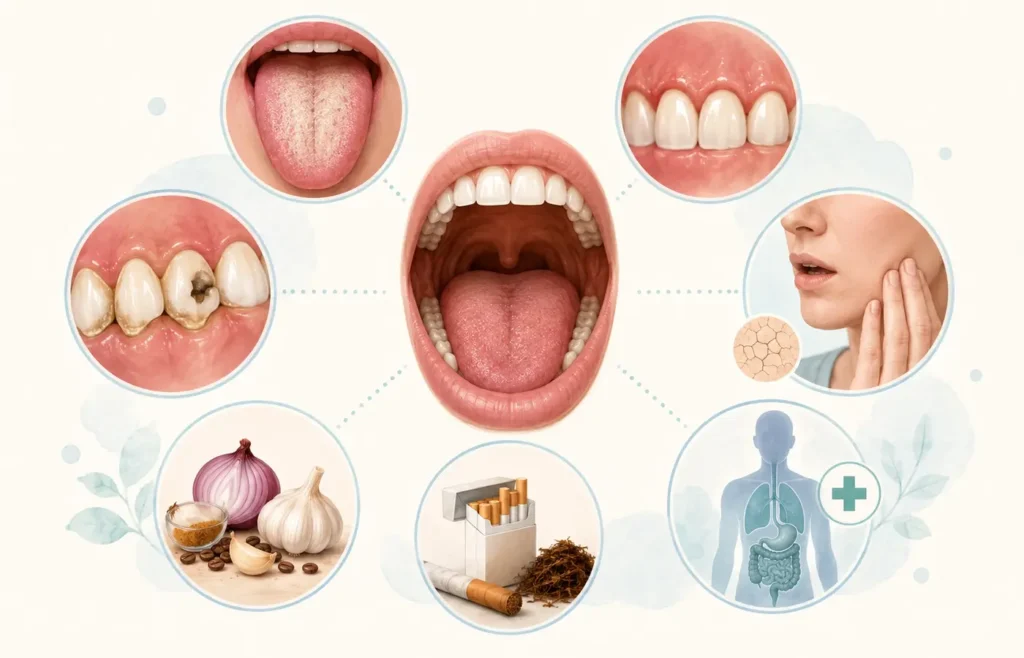
Halitosis is a symptom rather than a single disease.
According to the American Dental Association, common causes include oral bacteria, dry mouth, gum disease, food, tobacco and certain medical conditions.
In many cases, bacteria break down proteins and other material in the mouth and release volatile sulfur compounds.
The main compounds discussed in halitosis research include:
- Hydrogen sulfide.
- Methyl mercaptan.
- Dimethyl sulfide.
These compounds can produce odors compared with rotten eggs, cabbage or other sulfur-containing smells.
The back of the tongue is a particularly relevant location because its irregular surface can retain:
- Bacteria.
- Food debris.
- Saliva components.
- Shed cells.
- Tongue coating.
However, the tongue is not the only possible source.
| Possible source | Clues that may accompany it | Appropriate priority |
|---|---|---|
| Tongue coating and accumulated oral biofilm | Visible coating, morning odor or improvement after cleaning | Improve oral and tongue hygiene |
| Gum disease | Bleeding, swelling, recession, bad taste or loose teeth | Dental evaluation |
| Tooth decay or infection | Toothache, sensitivity, swelling or localized bad taste | Dental treatment |
| Dry mouth | Sticky mouth, low saliva, mouth breathing or medication use | Identify and manage the cause |
| Dentures, retainers or appliances | Odor associated with the appliance or incomplete cleaning | Clean correctly and obtain dental guidance |
| Smoking or tobacco | Persistent tobacco odor, dryness and gum irritation | Tobacco cessation and dental care |
| Food | Odor following garlic, onion, alcohol, coffee or other foods | Temporary dietary cause |
| Tonsil or sinus condition | Tonsil stones, throat symptoms, congestion or nasal odor | Medical or dental assessment |
| Reflux or another medical condition | Symptoms continue despite a healthy mouth | Medical evaluation after oral causes are assessed |
| Perceived odor without clinical confirmation | Persistent concern despite repeated reassurance | Professional breath assessment |
A probiotic will not address every row in this table.
How is ProDentim supposed to help bad breath?
The proposed mechanism is based on changing the oral microbial environment.
The idea is that selected beneficial microorganisms may:
- Compete with odor-associated bacteria.
- Occupy adhesion sites in the mouth.
- Produce substances that inhibit selected microorganisms.
- Influence oral biofilm composition.
- Reduce the microbial breakdown that produces sulfur compounds.
- Support a more balanced oral microbiome.
This mechanism is scientifically plausible for certain strains.
Plausibility does not establish that every oral probiotic works or that every person’s bad breath is caused by a probiotic-responsive microbial imbalance.
ProDentim uses a dissolvable oral format, which may provide more contact with the mouth than immediately swallowing a conventional capsule.
However, the local delivery format alone does not prove colonization, long-term microbiome change or clinical effectiveness.
Which ProDentim ingredients could affect breath?
The archived ProDentim label in the NIH Dietary Supplement Label Database lists:
- Lactobacillus paracasei.
- Lactobacillus reuteri.
- Bifidobacterium lactis BL-04.
- Streptococcus salivarius.
- Inulin.
- Natural strawberry flavor.
- Peppermint essential oil.
- Other tablet ingredients.
The first three microorganisms form a 3.5 billion CFU proprietary blend. The label does not disclose the amount assigned to each one.
The separate S. salivarius ingredient is listed as 20 mg without a CFU amount.
Lactobacillus paracasei
Selected L. paracasei strains have been studied for oral biofilms and other oral-health outcomes.
The ProDentim label does not identify an exact L. paracasei strain code.
This prevents a direct comparison between the product and strain-specific clinical trials.
Lactobacillus reuteri
Selected L. reuteri strains have been evaluated for periodontal outcomes, plaque and oral malodor.
However, ProDentim does not identify which L. reuteri strain it contains.
Research involving DSM 17938, ATCC PTA 5289 or another identified strain cannot automatically be applied to an unspecified L. reuteri ingredient.
Bifidobacterium lactis BL-04
BL-04 is the most precisely identified strain in the ProDentim probiotic blend.
Its better-known research relates primarily to immune and respiratory outcomes rather than direct treatment of chronic halitosis.
We could not identify a clinical trial demonstrating that BL-04, at the amount supplied by ProDentim, eliminates bad breath.
Streptococcus salivarius
This is the most potentially relevant label ingredient for the topic.
Specific S. salivarius strains, particularly K12 and M18, have been used in oral-malodor studies.
However, the archived ProDentim label states only Streptococcus salivarius.
It does not confirm:
- K12.
- M18.
- Another exact strain.
- The number of viable microorganisms.
- Whether the amount is guaranteed through expiration.
Evidence for K12 or M18 should therefore not be presented as evidence for ProDentim.
Inulin
Inulin is a prebiotic fiber that may serve as a substrate for selected microorganisms.
Its inclusion does not demonstrate that ProDentim’s probiotics survive, colonize the mouth or reduce volatile sulfur compounds.
The archived label lists 100 mg of inulin. We could not identify a trial showing that this amount improves halitosis as part of the complete ProDentim formula.
Peppermint essential oil
Peppermint may contribute to an immediate clean or fresh sensation.
That experience could come from:
- Aroma.
- Flavor.
- Increased saliva.
- The physical action of chewing or dissolving the tablet.
- Temporary masking of an existing odor.
It should not be confused with evidence of a lasting reduction in halitosis.
Does the current ProDentim website match the archived label?
Not completely.
The current official ProDentim presentation prominently discusses:
- L. paracasei.
- L. reuteri.
- B. lactis BL-04.
- Inulin.
- Peppermint.
- Other supporting ingredients.
It does not clearly highlight the separate S. salivarius found on the archived label.
The website also offers a digital bonus called “Bad Breath Gone. One Day Detox” and displays a customer testimonial about fresh breath.
A bonus guide and customer testimonial are not clinical evidence that ProDentim treats halitosis.
Because labels and formulas can change, purchasers should inspect the current physical Supplement Facts panel rather than assuming the archived label or sales presentation remains fully current.
Our complete ProDentim ingredients analysis examines these discrepancies in more detail.
Does ProDentim contain BLIS K12?
The reviewed label does not establish that it does.
It lists Streptococcus salivarius without the K12 strain designation.
This matters because K12 is not simply another name for the species. It is a specific strain.
A seller should not claim that ProDentim contains K12 unless the current manufacturer documentation or physical label confirms it.
The same limitation applies to BLIS M18.
What does clinical research say about probiotics for bad breath?
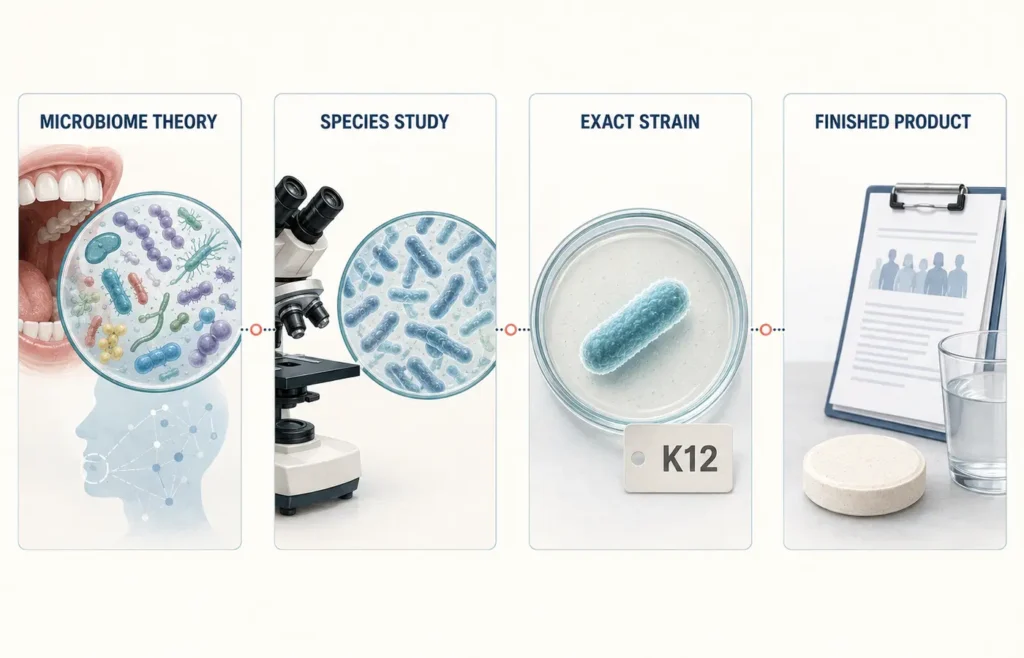
The evidence has become more favorable in some recent analyses, but it is not consistent enough to prove that every oral probiotic works.
2022 Frontiers systematic review
A systematic review and meta-analysis published in Frontiers in Nutrition included four randomized studies with 283 participants.
The studies evaluated K12, M18 and Weissella cibaria rather than ProDentim.
The combined analysis did not find a statistically significant overall difference between probiotics and control. The authors considered some results promising but emphasized the small number of studies, different protocols and need for stronger trials.
2022 BMJ Open meta-analysis
A BMJ Open systematic review and meta-analysis found that probiotics may improve selected organoleptic and volatile sulfur compound measurements in the short term.
The researchers did not find meaningful improvements in tongue-coating or plaque scores, and the durability of the effect beyond approximately four weeks remained uncertain.
Different strains and treatment protocols were combined, so the result does not identify a universal probiotic or establish a ProDentim effect.
2025 systematic review
A 2025 review of randomized controlled trials reported reductions in volatile sulfur compounds or odor scores in several included studies.
The authors also identified important limitations:
- Few eligible trials.
- Different probiotic strains.
- Different delivery formats.
- Inconsistent diagnostic methods.
- Limited long-term follow-up.
- Variation in additional oral-care procedures.
Latest systematic review and meta-analysis
A systematic review and meta-analysis published in the Journal of Breath Research evaluated 10 studies.
Some pooled analyses favored probiotics for volatile sulfur compounds and organoleptic improvement.
However, other assessed outcomes did not show significant differences. The authors also warned that publication bias, small samples and heterogeneity reduced confidence in the conclusions.
The analysis suggested that probiotics may be more useful when combined with conventional treatment than when used by themselves.
What do the reviews mean for ProDentim?
They support continued research into oral probiotics.
They do not prove that ProDentim works because:
- ProDentim was not the tested finished product.
- The exact ProDentim strains are mostly unknown.
- The individual CFU amounts are not disclosed.
- Study participants had different causes of halitosis.
- Some protocols included professional or antimicrobial treatment.
- The complete ProDentim formula has not been independently evaluated.
The correct conclusion is not that probiotics never help.
It is that the result depends on the exact strain, product, cause and treatment context.
What did the K12 clinical trial find?
A 2020 double-blind randomized trial evaluated S. salivarius K12 in 28 people with tongue-coating-associated halitosis.
Participants took K12 or placebo for 30 days without tongue scraping or antiseptic pretreatment.
The K12 group improved compared with its own baseline for selected measurements.
However, the more complete analysis did not find statistically significant differences between K12 and placebo for:
- Organoleptic scores.
- Volatile sulfur compounds.
- Tongue-coating scores.
The researchers concluded that K12 did not have a significant effect under those conditions and suggested that removing tongue coating may be necessary before probiotic use.
This study is relevant for two reasons.
First, even a specifically identified breath-oriented strain did not outperform placebo under every protocol.
Second, ProDentim does not confirm that its S. salivarius is K12.
What about studies involving Lactobacillus?
A 2019 randomized trial involved 60 participants with severe periodontitis.
Participants received professional periodontal treatment followed by either placebo or a combination containing:
- L. reuteri.
- L. salivarius.
- L. acidophilus.
The probiotic group showed improvements in periodontal and halitosis measurements after 90 days.
This does not prove that ProDentim will produce the same result.
The participants had severe periodontitis, received professional treatment and used a different multi-strain product. The exact strains and amounts cannot be assumed to match ProDentim.
The result is better interpreted as evidence that selected probiotics may have an adjunctive role in a defined periodontal-treatment protocol.
Fresh taste versus genuine halitosis improvement
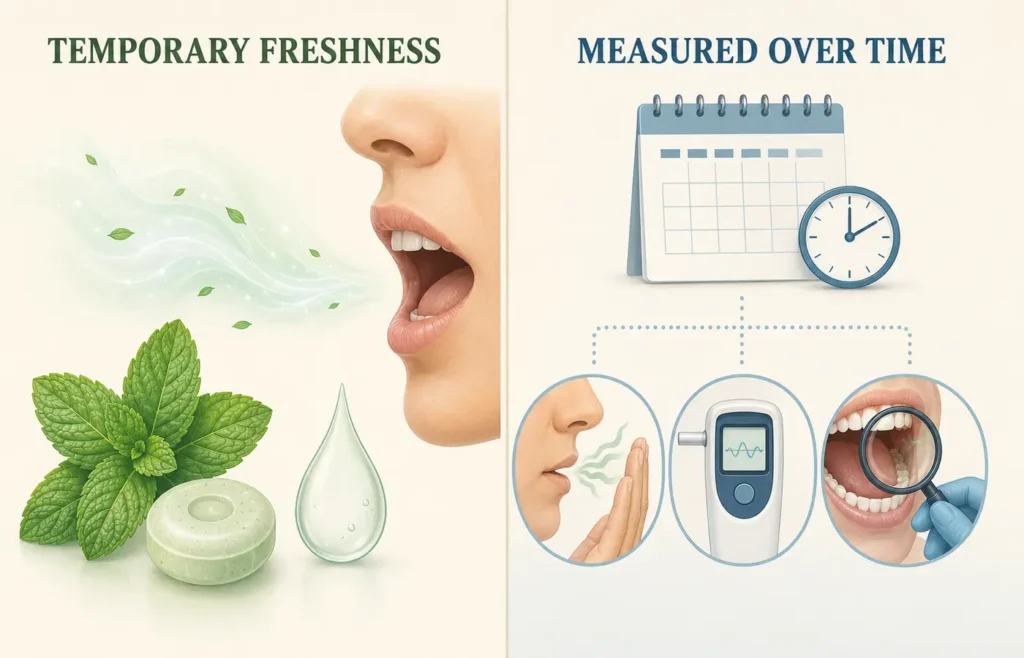
A person could notice a fresher taste within minutes of taking ProDentim.
That experience may be real without demonstrating a clinical probiotic effect.
| Immediate experience | Sustained clinical effect |
|---|---|
| Mint or strawberry taste | Lower measured volatile sulfur compounds |
| Increased saliva | Reduced organoleptic odor score |
| Temporary masking | Change that persists between doses |
| Cleaner mouthfeel | Improvement confirmed by another person or clinician |
| Effect immediately after the tablet | Improvement after flavor and aroma have disappeared |
If freshness occurs only while the mint flavor remains, the effect is more consistent with temporary freshening.
A probiotic effect would theoretically require microbial interaction over time, but ProDentim has no validated timeline for this outcome.
Which types of bad breath might ProDentim possibly help?
If ProDentim provides any probiotic benefit, the most biologically plausible candidate would be mild oral malodor associated with the oral microbial environment.
Even in that situation, effectiveness has not been proven.
Tongue-coating-associated odor
Oral probiotics have been evaluated for this type of halitosis.
However, existing research suggests that cleaning the tongue and controlling the coating may remain essential.
ProDentim should not be used as a substitute for physically managing a significant tongue coating.
Morning breath
Morning breath is often influenced by reduced saliva during sleep.
Chewing a flavored tablet in the morning may temporarily improve the sensation and stimulate saliva.
That does not establish that it corrected the underlying cause.
People with persistent morning dryness, mouth breathing, snoring or medication-related dry mouth should evaluate those factors.
Gum-related bad breath
Bad breath accompanied by bleeding, swollen or receding gums may indicate gum disease.
A probiotic cannot remove hardened tartar, clean a periodontal pocket or replace professional periodontal treatment.
Food-related odor
Odor caused by garlic, onion, alcohol or other foods may originate partly from compounds absorbed and later released through the lungs.
Changing oral bacteria may not eliminate this process.
Dry-mouth-related odor
A dissolvable tablet may temporarily increase saliva.
It does not necessarily treat the reason for persistent dry mouth.
The ADA’s information on xerostomia recommends identifying contributing conditions or medications and using appropriate dry-mouth management.
Bad breath from tonsil stones
No ProDentim trial shows that it removes or prevents tonsil stones.
Recurring tonsil stones, pain, swallowing difficulty or throat symptoms require appropriate professional evaluation.
Sinus-related odor
ProDentim’s sales presentation mentions respiratory and sinus support for selected ingredients.
This is not evidence that the product treats sinus infection, chronic rhinosinusitis or nasal-source halitosis.
Reflux-related breath
No clinical evidence shows that ProDentim treats reflux or reflux-related odor.
Persistent reflux symptoms should be discussed with an appropriate healthcare professional.
Bad breath from an infected tooth
An abscessed or infected tooth requires dental treatment.
A supplement cannot drain an abscess, repair decay or eliminate the need for a root canal, extraction or other necessary procedure.
How long would ProDentim take to improve bad breath?
There is no clinically validated ProDentim timeline for halitosis.
Possible experiences occur on different timelines.
Within minutes
Peppermint, flavoring, chewing and increased saliva may create temporary freshness.
This is not proof of a probiotic effect.
Within several days
Normal breath can vary because of:
- Diet.
- Hydration.
- Oral hygiene.
- Smoking.
- Sleep.
- Dry mouth.
- Time since the last meal.
- Time since brushing.
- Tongue coating.
An improvement during this period cannot automatically be attributed to ProDentim.
Within two to four weeks
Many probiotic studies evaluate outcomes after several weeks.
That study duration should not be converted into a promise that ProDentim will work within the same period.
Beyond four weeks
The long-term durability of probiotic treatment for halitosis remains uncertain.
Waiting several months for a supplement to work is inappropriate when there are signs of disease.
Our guide to how long ProDentim may take to work explains how to separate a study period from a guaranteed timeline.
How can you test ProDentim without confusing freshness with results?
A structured evaluation is more useful than relying on the taste immediately after taking the tablet.
1. Identify the goal
Define whether the concern is:
- Morning breath.
- Odor between meals.
- Persistent all-day halitosis.
- Bad taste.
- Gum-related odor.
- Dry-mouth-related odor.
- Odor noticed only after specific foods.
2. Keep the basic routine consistent
During the evaluation, avoid repeatedly changing:
- Toothpaste.
- Mouthwash.
- Tongue-cleaning frequency.
- Flossing habits.
- Diet.
- Smoking.
- Hydration.
- Multiple supplements.
Changing several factors at once makes it impossible to identify what produced the result.
3. Do not measure immediately after taking the tablet
Mint and strawberry flavoring can influence perception.
A more meaningful observation is whether breath remains improved after the flavor has disappeared and between daily servings.
4. Use an external assessment
People may become accustomed to their own breath and have difficulty evaluating it accurately.
A trusted person or dental professional may provide a more useful assessment.
Dental clinics can also use:
- Organoleptic evaluation.
- Sulfur-compound monitoring.
- Examination of the tongue.
- Periodontal evaluation.
- Assessment of teeth, restorations and appliances.
- Dry-mouth evaluation.
5. Record accompanying symptoms
Track whether the odor occurs with:
- Bleeding gums.
- Tooth pain.
- Swelling.
- Dryness.
- Coated tongue.
- Tonsil stones.
- Congestion.
- Reflux symptoms.
- Medication changes.
These details may reveal that the priority is diagnosis rather than supplementation.
6. Stop waiting when warning signs appear
Do not continue experimenting with supplements when there is:
- Toothache.
- Facial or gum swelling.
- Pus.
- Fever.
- Loose teeth.
- Significant bleeding.
- Difficulty swallowing.
- Difficulty breathing.
- A persistent unexplained bad taste.
- Worsening symptoms.
What should you do before trying ProDentim for bad breath?
A basic evidence-based routine should already be in place.
Brush with fluoride toothpaste
Brush thoroughly at least twice daily using a fluoride toothpaste.
ProDentim does not contain fluoride and cannot replace its established role in cavity prevention.
Clean between the teeth
Food debris and plaque can remain between teeth even when the visible surfaces appear clean.
Use floss or another interdental cleaning method appropriate for your teeth and gums.
Clean the tongue appropriately
The back of the tongue can retain significant odor-producing biofilm.
Tongue cleaning should be gentle. Excessive force can cause irritation or injury.
Clean dental appliances
Dentures, retainers, mouth guards and removable appliances require consistent cleaning according to professional instructions.
Address dry mouth
Stay appropriately hydrated and discuss persistent dryness with a dentist or healthcare professional.
Sugar-free gum or other saliva-supporting approaches may be appropriate for some people.
Treat dental disease
Cavities, gum disease, faulty dental work and infection require targeted treatment.
A probiotic cannot compensate for untreated disease.
Does ProDentim work better than mouthwash?
There is no head-to-head clinical trial comparing ProDentim with an established mouthrinse for halitosis.
The American Dental Association explains that selected mouthrinses may provide additional benefits for bad breath but do not replace brushing and interdental cleaning.
Different mouthrinses use ingredients that may:
- Kill selected bacteria.
- Reduce plaque.
- Neutralize sulfur compounds.
- Provide temporary flavor and freshness.
- Support dry-mouth management.
Some rinses are intended for daily consumer use, while others should be used only as professionally directed.
ProDentim should not be assumed to outperform a product with evidence for bad-breath control.
Is ProDentim better than a tongue scraper?
They serve different proposed functions.
A tongue scraper mechanically removes part of the coating and debris from the tongue.
ProDentim attempts to influence the oral environment through probiotic microorganisms and supporting ingredients.
Research involving K12 suggests that tongue-coating removal may be important before probiotic use in people whose halitosis originates from the tongue.
For visible tongue coating, physically controlling the source is generally more direct than relying on an unproven supplement.
Is a K12 probiotic more appropriate for bad breath?
K12 has a clearer strain-to-research connection than ProDentim’s unspecified S. salivarius.
That does not make K12 a guaranteed treatment.
The K12 evidence includes:
- Small samples.
- Different pretreatment procedures.
- Mixed clinical results.
- Different doses and durations.
- Limited long-term evidence.
Someone choosing an oral probiotic specifically because of K12 research should select a product that clearly identifies K12 and its viable count.
Our comparison of ProDentim versus other oral probiotics evaluates ProDentim, K12, M18 and BioGaia’s identified L. reuteri strains.
Can ProDentim make bad breath worse?
There is no reliable ProDentim clinical dataset showing how frequently breath improves, worsens or remains unchanged.
Potential reasons someone might perceive worsening include:
- The underlying disease continuing to progress.
- Reduced attention to normal oral hygiene.
- New dry mouth.
- A dietary or medication change.
- Digestive discomfort or reflux symptoms.
- An ingredient sensitivity.
- Assuming the tablet replaces tongue or interdental cleaning.
Stop using the product and seek appropriate guidance if symptoms begin after supplementation or become progressively worse.
Is ProDentim safe to use for halitosis?
The absence of a finished-product trial limits the ability to estimate ProDentim-specific adverse-event rates.
Probiotics are commonly tolerated by healthy individuals, but supplements are not risk-free for everyone.
Professional guidance is particularly appropriate for people who:
- Have a weakened immune system.
- Are seriously ill.
- Are pregnant or nursing.
- Take prescription medication.
- Have a significant gastrointestinal or medical condition.
- Are considering the product for a child.
- Have previously reacted to a supplement ingredient.
The official page advises people with medical conditions or prescription medications to show the product to their healthcare professional before using it.
It also describes the product as suitable for all ages and medical conditions. That broad marketing statement should not replace individualized medical advice.
When should persistent bad breath be professionally evaluated?
The NHS recommends seeing a dentist when bad breath does not improve after self-care for several weeks.
Dental assessment is also important when bad breath occurs with:
- Painful, bleeding or swollen gums.
- Toothache.
- Loose adult teeth.
- Denture problems.
- Persistent bad taste.
- Gum recession.
- Dry mouth.
- Visible decay.
- Repeated oral infections.
If a dentist finds that the mouth is healthy, further medical evaluation may be appropriate.
According to the Mayo Clinic, treatment depends on the cause and may involve control of plaque, dental disease or another underlying condition.
Facial swelling, fever, difficulty swallowing or difficulty breathing can indicate a more urgent problem and should not be managed with a supplement.
Is ProDentim worth buying for bad breath?
ProDentim may appeal to someone who:
- Wants a dissolvable oral probiotic.
- Understands that the evidence is indirect.
- Has already addressed oral hygiene and dental disease.
- Accepts the higher price.
- Is comfortable with incomplete strain-level disclosure.
- Is not expecting a guaranteed cure.
- Values its broader oral-wellness formula rather than a single targeted strain.
It is less compelling for someone who:
- Wants a clinically tested halitosis product.
- Wants a confirmed K12 or M18 strain.
- Needs treatment for gum disease, decay or infection.
- Has persistent unexplained halitosis.
- Wants individually disclosed strain doses.
- Expects permanent results.
- Is using the product instead of seeing a dentist.
ProDentim is also considerably more expensive than several oral probiotics that identify exact strains.
The broader formula does not prove that it is more effective for bad breath.
Frequently asked questions
Does ProDentim cure bad breath?
No evidence shows that ProDentim cures chronic halitosis.
It may temporarily freshen the mouth, and oral probiotics may help selected people, but the complete ProDentim formula has not been clinically established as a treatment.
Does ProDentim make your breath smell better immediately?
It may create an immediate fresh sensation because of peppermint, flavoring, chewing and increased saliva.
That effect does not prove that odor-producing bacteria or volatile sulfur compounds were reduced.
Is ProDentim specifically made for halitosis?
The product is broadly positioned for teeth, gums and the oral microbiome.
The official offer includes a separate bad-breath digital bonus, but ProDentim has not been clinically validated as a halitosis treatment.
Does ProDentim contain Streptococcus salivarius?
The archived label lists S. salivarius separately.
The current sales presentation does not clearly emphasize it, so purchasers should verify the physical label.
Does ProDentim contain BLIS K12?
The reviewed label does not identify its S. salivarius as K12.
K12 studies should not be attributed to ProDentim without confirmation.
Does ProDentim contain BLIS M18?
The reviewed label does not identify M18.
Research involving M18 does not directly prove that ProDentim works.
Does Lactobacillus reuteri help bad breath?
Selected L. reuteri strains have been included in studies involving oral malodor and periodontal treatment.
ProDentim does not identify its exact L. reuteri strain, and no study proves that its finished formula produces the same outcome.
Can ProDentim help morning breath?
The tablet may provide temporary freshness and stimulate saliva in the morning.
Persistent morning odor may still require attention to tongue coating, dry mouth, mouth breathing, oral hygiene or dental disease.
Can ProDentim help bad breath caused by gum disease?
It cannot replace professional periodontal treatment.
Selected probiotics have been studied as additions to periodontal care, but untreated gum disease requires dental assessment.
Can ProDentim help bad breath from cavities?
It cannot repair or treat a cavity.
A decayed or infected tooth requires dental evaluation and appropriate treatment.
Can ProDentim remove tonsil stones?
No clinical evidence shows that ProDentim removes tonsil stones.
Can ProDentim treat bad breath caused by reflux?
No evidence shows that it treats reflux or reflux-related odor.
Should ProDentim be taken before or after brushing?
The official sales page recommends slowly chewing one tablet in the morning but does not provide a clinically validated timing protocol for halitosis.
Follow the current physical label and do not replace normal brushing or interdental cleaning.
How many bottles are needed to test ProDentim for bad breath?
There is no validated number of bottles for halitosis.
Buying multiple bottles does not increase the quality of the evidence. Consider the total upfront cost and refund requirements before purchasing a larger package.
Should I combine ProDentim with another oral probiotic?
No research shows that combining ProDentim with K12, M18 or another oral probiotic provides better breath control.
Using several products increases cost and makes it harder to identify which product caused a benefit or reaction.
Can probiotics permanently eliminate halitosis?
Current evidence does not establish permanent elimination.
Results depend on the strain, cause, accompanying treatment and continued control of oral biofilm or disease.
Why does my breath improve only while the tablet is dissolving?
That pattern is more consistent with flavor, aroma, saliva stimulation or temporary masking than with a lasting change in the oral microbiome.
Are oral probiotics FDA approved for halitosis?
No oral probiotic supplement should be described as FDA approved for treating halitosis.
The FDA explains that dietary supplements are not approved for safety and effectiveness before marketing.
Final verdict: Can ProDentim really help halitosis?
ProDentim could temporarily make the mouth feel fresher.
Whether it produces a meaningful and sustained improvement in halitosis is unknown.
The scientific case in its favor is based on:
- A dissolvable oral format.
- Several probiotic microorganisms.
- A plausible oral-microbiome mechanism.
- Peppermint and flavoring.
- General research suggesting selected probiotics may reduce oral malodor.
The limitations are more important:
- No published ProDentim halitosis trial.
- No trial of the complete finished formula.
- Limited exact-strain disclosure.
- No individual CFU amounts.
- No CFU disclosure for the separate S. salivarius.
- No confirmation of K12 or M18.
- Differences between the archived label and current presentation.
- Mixed findings across oral-probiotic reviews.
- No evidence that it treats the many dental and medical causes of bad breath.
The practical conclusion is:
- ProDentim may be considered an optional supplement for someone who understands the uncertainty and has already addressed oral hygiene and dental causes.
- It should not be considered a proven halitosis treatment.
- Immediate minty freshness should not be confused with a probiotic effect.
- Persistent bad breath should be evaluated rather than repeatedly masked.
- Pain, swelling, bleeding, loose teeth, infection or significant dryness require professional attention.
For a broader assessment of the formula, pricing, evidence and refund policy, read our complete ProDentim review.
If you understand these limitations and still want to evaluate its broader oral-probiotic formula, you can view the current ProDentim offer.
Medical disclaimer: This article is provided for general informational purposes only and does not replace advice, diagnosis or treatment from a qualified dental or healthcare professional.
Sources
- Official ProDentim Text Presentation
- NIH Dietary Supplement Label Database: ProDentim
- American Dental Association: Bad Breath
- American Dental Association: Mouthrinse
- American Dental Association: Xerostomia
- Mayo Clinic: Bad Breath Diagnosis and Treatment
- NHS: Bad Breath
- Role of Probiotics in Halitosis of Oral Origin
- Efficacy of Probiotics in the Management of Halitosis
- Effectiveness of Probiotics in Managing Oral Halitosis
- Efficacy and Safety of Probiotic Therapy for Halitosis
- Effect of Streptococcus salivarius K12 on Halitosis
- Lactobacillus Trial in Periodontitis and Halitosis
- FDA: Questions and Answers on Dietary Supplements