
Affiliate disclosure: This article contains affiliate links. If you purchase through our links, Only For U Deals may earn a commission at no additional cost to you.
Can ProDentim help gum disease?
It should not be considered a proven treatment for gingivitis or periodontitis.
ProDentim contains microorganisms associated with oral-health research, including Lactobacillus reuteri. However, we could not identify a published clinical trial evaluating the complete ProDentim formula in people with gum disease.
Studies involving other oral probiotics have reported some short-term improvements in plaque, gum bleeding or periodontal measurements. Those results usually involve exact strains, defined doses and products different from ProDentim.
In periodontitis studies, probiotics are also normally used after professional periodontal treatment, not as replacements for it.
ProDentim cannot:
- Remove hardened tartar.
- Clean periodontal pockets.
- Restore lost bone.
- Reattach gum tissue to a tooth.
- Stabilize a loose tooth.
- Replace scaling and root planing.
- Diagnose the cause of bleeding gums.
Our assessment, updated on July 30, 2026, is that ProDentim may be considered an optional oral-wellness supplement after gum disease has been properly evaluated and treated.
It should not be used to postpone dental care.
Quick verdict: Does ProDentim work for gum disease?
| Question | Evidence-based answer |
|---|---|
| Has ProDentim been clinically tested for gingivitis? | No published finished-product trial was identified |
| Has it been tested for periodontitis? | No published finished-product trial was identified |
| Are probiotics studied for gum health? | Yes, with mixed and strain-specific results |
| Does ProDentim disclose all exact strains? | No |
| Can it remove plaque and tartar? | It cannot remove hardened tartar and should not replace plaque control |
| Can it stop bleeding gums? | Not clinically established |
| Can it reverse gum recession? | No evidence shows that it regrows lost gum tissue |
| Can it restore periodontal bone loss? | No |
| Can it replace scaling and root planing? | No |
| Overall verdict | Plausible as an optional adjunct, but not proven as a treatment |
The distinction between an adjunct and a treatment replacement is essential.
An adjunct is added to established care. It does not perform the work of professional cleaning, daily plaque removal or periodontal therapy.
Gingivitis versus periodontitis
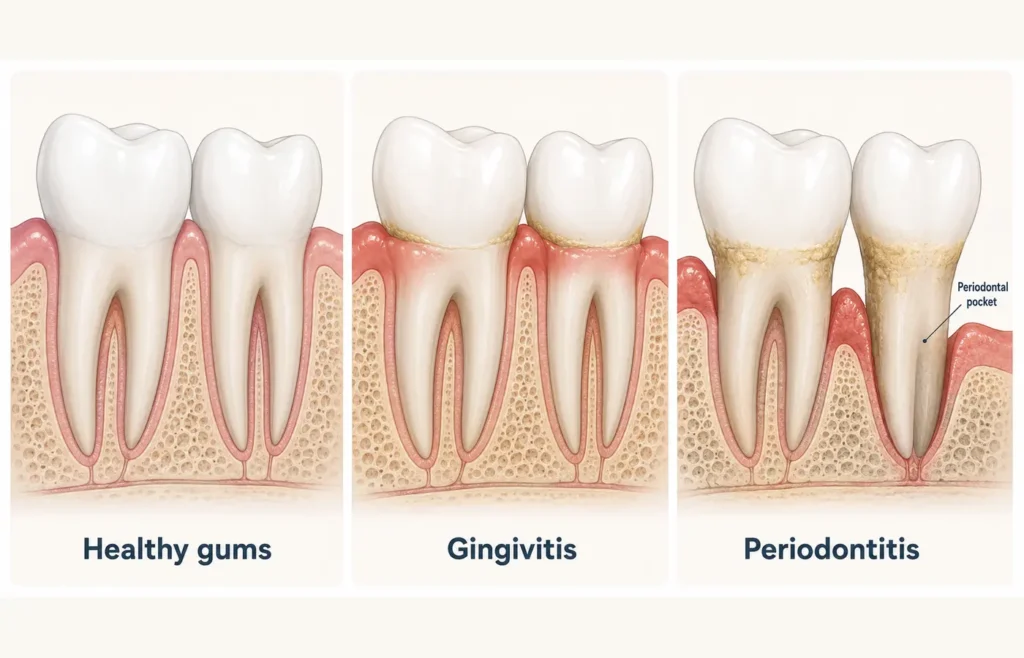
“Gum disease” can describe conditions with very different levels of severity.
| Condition | What happens | Can ProDentim treat it? |
|---|---|---|
| Gingivitis | Gums become inflamed, red, swollen or prone to bleeding, without periodontal bone loss | Not clinically established |
| Periodontitis | Inflammation affects the tissues and bone supporting the teeth, with periodontal pockets and possible attachment loss | No evidence that ProDentim treats or reverses it |
| Gum recession | The gum margin moves away from its previous position and exposes more of the tooth or root | No evidence that ProDentim regrows gum tissue |
| Temporary irritation | Gums may become irritated by aggressive brushing, trapped food, an appliance or another local factor | The cause must be identified |
The National Institute of Dental and Craniofacial Research explains that plaque which is not removed can harden into tartar. Only a dental professional can remove that hardened material.
Plaque-induced gingivitis can often be reversed when plaque is controlled and professional care is provided.
Periodontitis is more serious. It can create deeper pockets around teeth and damage the bone and connective tissue that hold them in place.
A supplement cannot determine which condition a person has.
How is ProDentim supposed to support the gums?
ProDentim is based on the idea that selected beneficial microorganisms may influence the oral microbiome.
Possible probiotic mechanisms include:
- Competing with selected periodontal pathogens.
- Producing antimicrobial substances.
- Influencing the formation of oral biofilm.
- Modulating local inflammatory responses.
- Supporting a more balanced microbial environment.
These mechanisms are biologically plausible for certain probiotic strains.
However, periodontal disease is not simply a shortage of “good bacteria.” It involves a complex interaction between:
- Dental biofilm.
- The immune response.
- Oral-hygiene habits.
- Smoking.
- Diabetes and other health conditions.
- Genetics.
- Medication.
- Access to professional care.
- Previous periodontal damage.
Adding probiotics does not physically remove plaque or calculus from below the gumline.
Which ProDentim ingredients are relevant to gum health?
The archived ProDentim label in the NIH Dietary Supplement Label Database lists:
- Lactobacillus paracasei.
- Lactobacillus reuteri.
- Bifidobacterium lactis BL-04.
- Streptococcus salivarius.
- Inulin.
- Peppermint essential oil.
- Supporting tablet ingredients.
The first three microorganisms are included in a proprietary blend totaling 3.5 billion CFUs. The amount supplied by each microorganism is not disclosed.
The separate S. salivarius ingredient is listed in milligrams rather than CFUs.
Lactobacillus reuteri
This is the most relevant ProDentim ingredient for periodontal research.
Identified L. reuteri strains such as DSM 17938 and ATCC PTA 5289 have been evaluated in gingivitis and periodontitis studies.
Some trials reported improvements in:
- Bleeding on probing.
- Gingival inflammation.
- Plaque measurements.
- Periodontal pocket depth.
- Selected periodontal bacteria.
Other trials found microbiological changes without a significant clinical improvement.
ProDentim lists L. reuteri without confirming DSM 17938, ATCC PTA 5289 or another exact strain.
The results from those identified strains cannot automatically be transferred to ProDentim.
Lactobacillus paracasei
Selected L. paracasei strains have been studied for biofilm, oral bacteria and gingival-health outcomes.
ProDentim does not identify its exact L. paracasei strain.
A species name alone is insufficient to establish that the ingredient has the same properties as a strain used in a clinical trial.
Bifidobacterium lactis BL-04
BL-04 is the most precisely identified strain in ProDentim’s main probiotic blend.
However, periodontal research involving B. lactis often evaluates a different strain called HN019.
A randomized clinical trial involving B. lactis HN019 reported additional benefits when the probiotic was used with scaling and root planing.
That study does not prove that BL-04 produces the same results.
HN019 and BL-04 are different strains, and ProDentim was not the tested product.
Streptococcus salivarius
The archived label lists S. salivarius but does not provide an exact strain code.
Selected strains, including BLIS M18, have been investigated for oral biofilm and gingival outcomes. Evidence involving M18 cannot be applied to an unspecified S. salivarius ingredient.
The current official ProDentim presentation also does not clearly feature S. salivarius among the three principal probiotics.
Consumers should examine the current physical label because formulas and ingredient presentations can change.
Inulin and peppermint
Inulin is a prebiotic fiber intended to support selected microorganisms.
Peppermint may contribute flavor, freshness and a temporary clean-mouth sensation.
Neither ingredient has been shown to remove tartar, close periodontal pockets or regenerate damaged periodontal tissue as part of ProDentim.
Our complete ProDentim ingredients analysis explains the difference between ingredient evidence and finished-product evidence.
What does clinical research say about probiotics and gum disease?
The overall evidence is mixed.
Some studies report improvements, but the effect depends on:
- The exact probiotic strain.
- The dose.
- The delivery format.
- The duration.
- The type and severity of gum disease.
- Whether professional treatment was provided.
- Which periodontal outcome was measured.
Evidence for gingivitis
A systematic review and meta-analysis of gingivitis trials included 10 double-blind randomized studies.
Although individual studies reported favorable results, the pooled analysis for L. reuteri did not show statistically significant improvements in gingival or plaque indexes compared with placebo.
The authors characterized the evidence as weak because of limited data and substantial differences among studies.
A 2025 systematic review and meta-analysis reached a similarly cautious conclusion for gingivitis. Plaque and bleeding measurements were lower in probiotic groups, but the differences were not statistically significant.
This means oral probiotics remain interesting for research, but they are not established replacements for controlling plaque.
Evidence for periodontitis
The periodontal evidence is somewhat more encouraging, particularly when probiotics are added to nonsurgical treatment.
The 2025 meta-analysis found improvements in selected plaque and bleeding measurements among people with periodontitis.
However, that does not mean probiotics treated periodontitis independently.
The studies generally evaluated probiotics as additions to interventions such as:
- Scaling and root planing.
- Professional mechanical plaque removal.
- Oral-hygiene instruction.
- Periodontal maintenance.
A 2025 umbrella review examined numerous systematic reviews involving periodontal and peri-implant treatment.
Some reviews reported clinically relevant adjunctive benefits, while others did not. The authors concluded that the evidence remained conflicting and that no definitive conclusion could be made.
They also found no reliable evidence establishing long-term benefits.
What do professional guidelines say?
The European Federation of Periodontology has acknowledged the scientific interest in probiotics.
Its clinical guideline nevertheless suggested not using probiotics as an adjunct to subgingival instrumentation because the available trials were not sufficiently robust to establish a meaningful and predictable clinical benefit.
The EFP identified several limitations:
- Small trials.
- Insufficient statistical power.
- Limited follow-up.
- Different probiotic formulations.
- Inconsistent outcomes.
- Lack of multicenter studies.
- Uncertain cost-to-benefit value.
This recommendation may change if stronger evidence becomes available. It currently does not support presenting probiotics as routine periodontal treatment.
Why exact strains matter
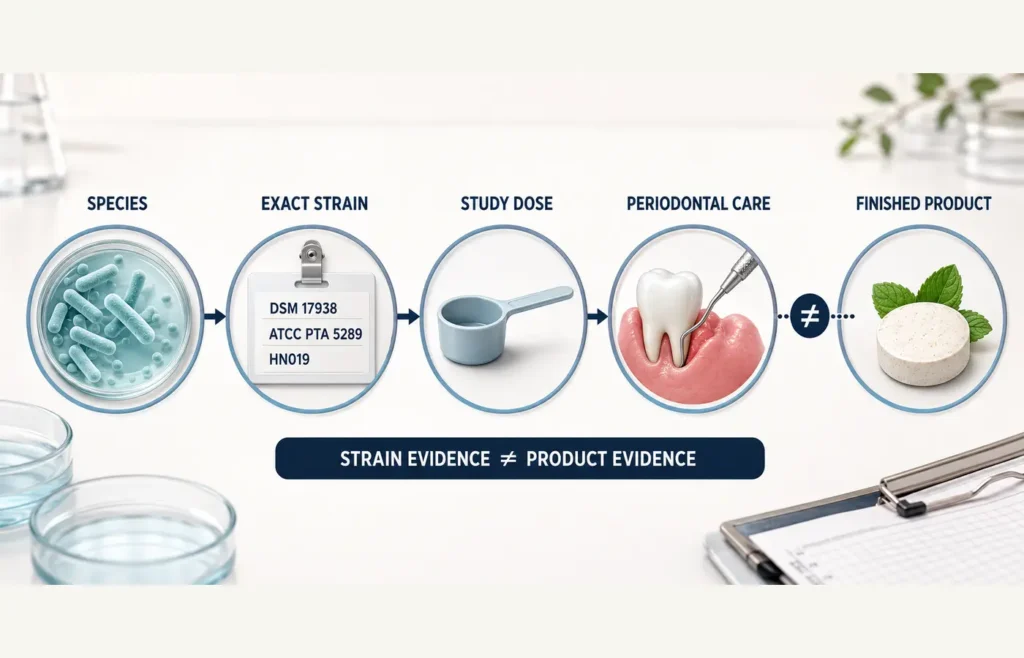
Probiotic evidence follows a more specific chain than many supplement advertisements imply:
Species → exact strain → dose → delivery method → tested population → finished product
For example:
- Research on L. reuteri DSM 17938 does not prove that every L. reuteri product works.
- Research on B. lactis HN019 does not prove an effect from BL-04.
- Research on a probiotic used after scaling and root planing does not prove that the probiotic works alone.
- Research lasting several weeks does not establish permanent protection.
- Research measuring bacterial counts does not necessarily demonstrate an improvement in bleeding, pockets or attachment loss.
ProDentim does not disclose enough strain- and dose-level information to reproduce most periodontal protocols.
Can ProDentim help specific gum symptoms?
| Symptom or concern | What it may indicate | What ProDentim can realistically do |
|---|---|---|
| Bleeding while brushing | Gingivitis, periodontitis, irritation or another condition | No proven ProDentim treatment effect |
| Red or swollen gums | Inflammation associated with plaque or another cause | May be tested only as an optional adjunct after evaluation |
| Gum recession | Periodontal disease, aggressive brushing, tooth position or other factors | Cannot regrow lost gum tissue |
| Deep gum pockets | Periodontitis | Cannot clean or close pockets by itself |
| Tartar buildup | Hardened plaque | Cannot remove it |
| Loose teeth | Advanced support loss, trauma or another serious problem | Requires prompt dental care |
| Persistent bad breath | Tongue coating, gum disease, dry mouth or another cause | May temporarily freshen the mouth but does not diagnose the cause |
| Bone loss on an X-ray | Periodontal destruction or another condition | Cannot regenerate bone |
A change in gum appearance is not enough to determine whether a product is working.
Meaningful periodontal assessment may include:
- Bleeding on probing.
- Pocket-depth measurements.
- Clinical attachment measurements.
- Plaque levels.
- Gum recession.
- Tooth mobility.
- Dental X-rays.
- Comparison over time.
Can ProDentim reverse gingivitis?
There is no ProDentim clinical trial showing that it reverses gingivitis.
Plaque-induced gingivitis is often reversible, but improvement usually depends on removing the biofilm responsible for the inflammation.
According to the NIDCR’s oral-hygiene guidance, this includes brushing, cleaning between the teeth and obtaining professional care when needed.
If someone starts ProDentim while simultaneously improving brushing and interdental cleaning, the gums may improve.
That improvement should not automatically be attributed to the supplement.
Can ProDentim treat periodontitis?
No evidence shows that ProDentim treats periodontitis.
Periodontitis can involve:
- Infection and inflammation below the gumline.
- Deepening periodontal pockets.
- Loss of connective-tissue attachment.
- Loss of supporting bone.
- Gum recession.
- Tooth mobility.
- Tooth loss.
A chewable supplement cannot mechanically remove subgingival calculus or perform periodontal instrumentation.
Selected probiotic strains may eventually have a clearer role as additions to professional treatment. That is different from treating periodontitis with ProDentim alone.
Can ProDentim regrow receding gums?
No.
There is no clinical evidence that ProDentim regenerates lost gingival tissue or returns a receded gumline to its former position.
Treatments for recession depend on its cause and severity. They may include:
- Changing traumatic brushing habits.
- Controlling inflammation.
- Treating periodontal disease.
- Managing tooth position or bite-related factors.
- Monitoring stable recession.
- Periodontal grafting or another professional procedure.
Claims that a probiotic can “restore” or “rebuild” receding gums should be treated cautiously unless supported by direct clinical evidence.
What should evidence-based gum treatment include?
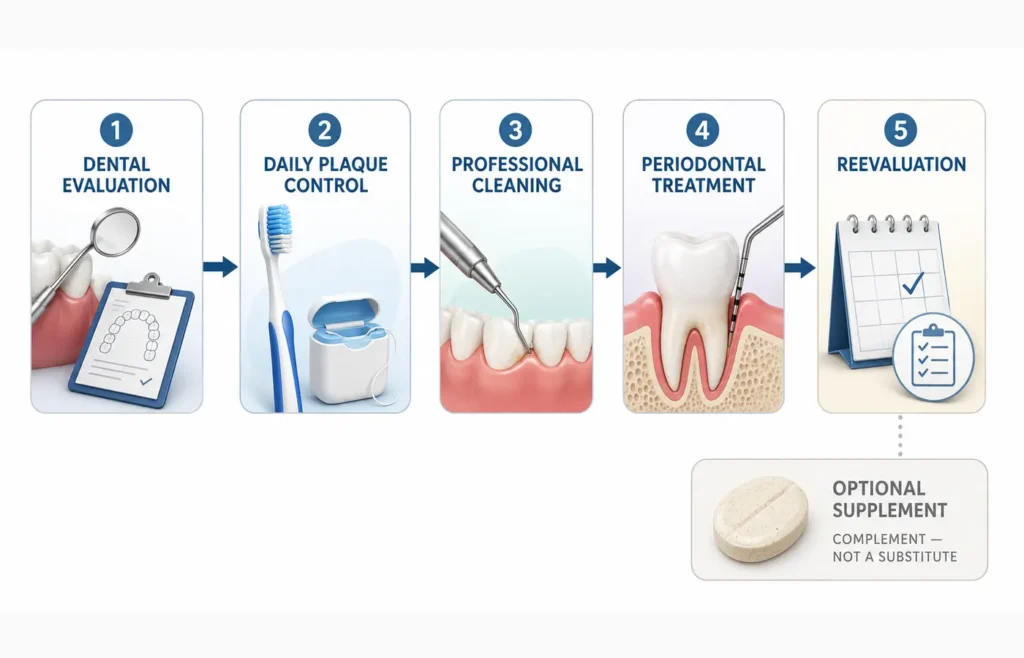
Effective daily plaque control
Brush twice daily with fluoride toothpaste and clean between the teeth using a method appropriate for your mouth.
An interdental brush may be more effective than conventional floss in some larger spaces, but a dental professional can recommend the best option.
Professional examination
A dentist or periodontist can determine whether bleeding comes from gingivitis, periodontitis, local irritation or another condition.
The examination may include pocket measurements and X-rays.
Professional cleaning or periodontal treatment
Regular cleaning may be sufficient for plaque-induced gingivitis.
Periodontitis may require scaling and root planing, repeated instrumentation, periodontal surgery or another individualized treatment.
Risk-factor management
Smoking is a major periodontal risk factor and can reduce treatment success.
Diabetes control, medication review, dry-mouth management and consistent maintenance may also affect outcomes.
Periodontal maintenance
Successful treatment does not permanently eliminate the need for follow-up.
People with a history of periodontitis commonly require an individualized supportive-care schedule.
How could someone evaluate ProDentim as an optional adjunct?
Someone who has already received appropriate dental care may still decide to test ProDentim as a supplement.
A more responsible approach would be:
- Obtain a diagnosis before beginning.
- Complete any recommended professional treatment.
- Keep brushing and interdental cleaning consistent.
- Avoid starting several supplements simultaneously.
- Follow the current physical product label.
- Do not judge the result only by flavor or mouthfeel.
- Compare gum bleeding and professional measurements over time.
- Stop waiting for the supplement if symptoms worsen.
There is no clinically validated ProDentim timeline for gum disease.
A study lasting four, eight or twelve weeks does not guarantee that ProDentim will work within the same period.
Our guide to how long ProDentim may take to work explains why research durations should not be converted into promises.
Is ProDentim safe for people with gum disease?
The absence of a finished-product periodontal trial limits ProDentim-specific safety information.
Probiotics are commonly tolerated by healthy adults, but professional guidance is appropriate for people who:
- Have a weakened immune system.
- Are seriously ill.
- Are pregnant or nursing.
- Take prescription medication.
- Have a significant medical condition.
- Are considering the product for a child.
- Have reacted to supplements previously.
- Recently underwent oral surgery.
- Have an active dental infection.
The official ProDentim page advises people with medical conditions or prescription medications to consult a healthcare professional.
Its broad statement that the product was designed for all ages and medical conditions should not replace individualized advice.
When should bleeding gums be evaluated?
Arrange a dental assessment when gum bleeding:
- Persists despite improved cleaning.
- Occurs frequently.
- Happens spontaneously.
- Is accompanied by swelling or pain.
- Appears with gum recession.
- Occurs around a loose tooth.
- Is associated with pus or a persistent bad taste.
- Appears with persistent bad breath.
- Develops after a medication change.
- Occurs in someone with diabetes or another relevant condition.
Seek more urgent care for:
- Facial swelling.
- Fever.
- Rapidly worsening pain.
- Difficulty swallowing.
- Difficulty breathing.
- Significant uncontrolled bleeding.
These signs should not be managed by waiting for a probiotic supplement to work.
Is ProDentim worth buying for gum health?
ProDentim may appeal to someone who:
- Wants a dissolvable oral probiotic.
- Has already addressed plaque and professional treatment.
- Understands that the evidence is indirect.
- Accepts incomplete strain disclosure.
- Is interested in general oral wellness rather than treatment.
- Does not expect gum or bone regeneration.
- Can afford the product without postponing dental care.
It is less compelling for someone who:
- Wants a clinically tested gum-disease product.
- Has untreated bleeding or swollen gums.
- Has deep periodontal pockets.
- Needs tartar removal.
- Has gum recession or loose teeth.
- Wants the exact researched L. reuteri strains.
- Expects the supplement to replace periodontal treatment.
- Wants individually disclosed CFU amounts.
ProDentim’s broader formula does not prove that it is more effective than a targeted strain or established oral-care product.
Our ProDentim versus other oral probiotics comparison examines strain disclosure, evidence, cost and practical use.
Frequently asked questions
Does ProDentim cure gum disease?
No evidence shows that ProDentim cures gingivitis or periodontitis.
Does ProDentim stop bleeding gums?
It has not been clinically tested for this outcome as a finished product. Persistent bleeding requires evaluation and effective plaque control.
Can ProDentim remove tartar?
No. Hardened tartar must be removed professionally.
Can ProDentim reverse periodontal pockets?
No clinical evidence shows that it closes periodontal pockets or restores lost attachment.
Can ProDentim regrow gums?
No evidence shows that it regenerates receded gum tissue.
Can ProDentim rebuild bone around teeth?
No. It has not been shown to regenerate periodontal bone loss.
Does ProDentim contain the same Lactobacillus reuteri strains used in periodontal trials?
The reviewed label does not confirm DSM 17938 or ATCC PTA 5289.
Is ProDentim better than scaling and root planing?
They are not equivalent. Scaling and root planing physically removes deposits and disrupts biofilm below the gumline. ProDentim cannot perform that function.
Can ProDentim be taken after periodontal treatment?
A healthy adult may discuss it as an optional adjunct with a dental professional. There is no validated ProDentim protocol for post-treatment use.
Why did my gums improve after starting ProDentim?
Improvement could result from better brushing, interdental cleaning, professional care, natural variation or another simultaneous change. Without a controlled comparison, the cause cannot be confirmed.
Should I stop brushing if my gums bleed?
No. Avoid aggressive force, but do not abandon oral hygiene. Persistent bleeding should be evaluated so the technique and underlying cause can be addressed.
Is ProDentim FDA approved for treating gum disease?
No. The FDA explains that dietary supplements are not approved for safety and effectiveness before marketing.
Final verdict: Can ProDentim help gingivitis or periodontitis?
ProDentim has a plausible oral-probiotic concept, but it is not a clinically proven treatment for gum disease.
The case in its favor includes:
- A dissolvable oral format.
- Inclusion of L. reuteri and other microorganisms.
- General research supporting continued study of oral probiotics.
- Some favorable trials involving exact probiotic strains.
- Possible short-term adjunctive periodontal benefits.
The major limitations are:
- No published finished-product gum-disease trial.
- No evidence that ProDentim works independently.
- Incomplete exact-strain disclosure.
- No individual CFU amounts.
- No confirmation of the L. reuteri strains most frequently studied.
- BL-04 is not the same strain as the periodontal HN019 studies.
- Conflicting systematic-review findings.
- Lack of established long-term benefit.
- A clinical guideline that does not recommend routine adjunctive probiotic use.
- No ability to remove tartar or repair periodontal destruction.
The practical conclusion is:
- ProDentim may be considered an optional supplement after diagnosis and treatment.
- It should not replace brushing, interdental cleaning or professional care.
- It cannot reverse bone loss, periodontal pockets or gum recession.
- Persistent bleeding should be investigated rather than masked.
- Loose teeth, swelling, pus, pain or fever require prompt attention.
For the broader formula, safety, price and refund assessment, read our complete ProDentim review.
If you understand these limitations and still want to evaluate ProDentim as an oral-wellness supplement, you can view the current ProDentim offer.
Medical disclaimer: This article is provided for general informational purposes only and does not replace advice, diagnosis or treatment from a qualified dental or healthcare professional.
Sources
- Official ProDentim Text Presentation
- NIH Dietary Supplement Label Database: ProDentim
- NIDCR: Periodontal Gum Disease
- NIDCR: Oral Hygiene
- European Federation of Periodontology: Probiotics and Periodontal Treatment
- Clinical Efficacy of Probiotics in Gingivitis
- Clinical Effects of Probiotics on Gingivitis and Periodontitis
- Effects of Probiotic Therapy on Periodontal Treatment: Umbrella Review
- Bifidobacterium lactis HN019 Periodontitis Trial
- Lactobacillus reuteri Gingivitis Trial
- Lactobacillus reuteri Trial in Navy Sailors
- FDA: Questions and Answers on Dietary Supplements