Affiliate disclosure: This article may contain affiliate links. If you use our links, Only For U Deals may earn a commission at no extra cost to you.
A free VIN check can help you confirm basic vehicle details, look for open safety recalls, and search certain theft or salvage records before buying a used car. What it usually cannot provide is a complete history of every accident, title event, repair, owner, or mechanical problem.
The safest approach is to combine several free official resources, compare the results with the seller’s documents, and consider a more complete vehicle history report and an independent inspection once a car becomes a serious option.
What can a free VIN check show?
A VIN, or Vehicle Identification Number, is a unique 17-character code used on most modern vehicles. It can identify information encoded by the manufacturer and connect a specific car to records held by government agencies, insurers, title systems, and commercial data providers.
Depending on the tool and available data, a free lookup may help you check:
- the vehicle’s make, model year, body type, engine, and manufacturing information;
- whether a specific VIN has an unrepaired safety recall listed by NHTSA;
- certain unrecovered theft or salvage records reported by participating insurers;
- whether the VIN in the listing matches the vehicle and its documents;
- a limited preview showing that additional history records may exist.
The word “free” is important. Some websites offer only a VIN decoder or a limited preview for free, then charge for the full report. Read what the tool actually covers before treating its result as a complete vehicle history.
Four places to check a VIN before you pay
1. NHTSA VIN Decoder
The official NHTSA VIN Decoder can identify information encoded in the VIN, including vehicle specifications and the plant and country of manufacture. NHTSA notes that the displayed information is reported by the manufacturer.
This is useful for confirming that the seller’s listing describes the same year, make, model, and configuration connected to the VIN. It is a decoder, however, not a complete accident or ownership history.
2. NHTSA Recall Lookup
Use the free NHTSA recall lookup to check whether a VIN has an unrepaired safety recall available in the system. An open recall does not automatically make a vehicle a bad purchase, but you should understand the problem and confirm the repair process before buying.
A result showing no unrepaired recalls is not the same as a full history report. It answers a specific safety question and should be used as one step in a broader review.
3. NICB VINCheck
The National Insurance Crime Bureau provides a free NICB VINCheck service. It can help determine whether a participating NICB member reported a vehicle as stolen and unrecovered or as a salvage vehicle.
NICB clearly warns that its database is limited. Not every stolen, total-loss, or salvage vehicle appears in the service, and NICB does not independently verify every record. A “no record” result should never be interpreted as proof that the car has a clean history.
4. NMVTIS consumer resources
The National Motor Vehicle Title Information System, or NMVTIS, is a U.S. Department of Justice system designed to help protect consumers from fraud and unsafe vehicles. Its consumer site explains vehicle history records and lists approved public data providers.
NMVTIS reports are generally obtained through an approved provider and may require payment. They can include important title, brand, odometer, junk, salvage, and insurance total-loss information, but the official consumer disclaimer explains that no report contains every possible fact about a vehicle.
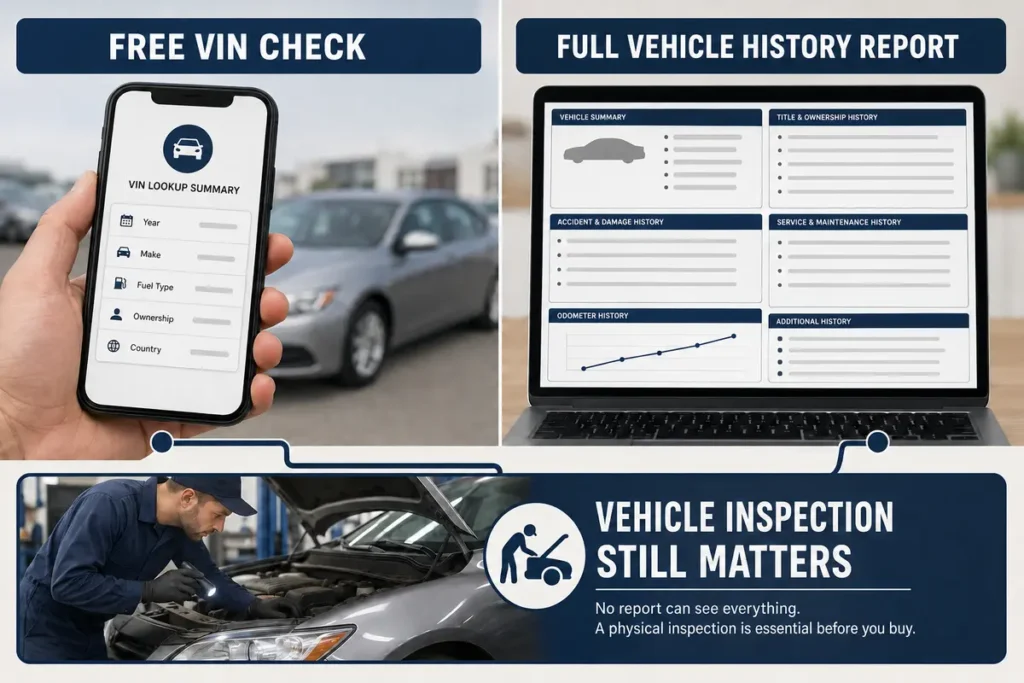
Free VIN check vs. paid vehicle history report
| Question | Free official checks | More complete paid report |
|---|---|---|
| Can it decode the VIN? | Often, yes | Usually |
| Can it show open recalls? | Yes, through NHTSA’s recall tool | Sometimes included, depending on provider |
| Can it show theft or salvage records? | Some records through NICB and other sources | May include broader title, theft, and total-loss data |
| Can it show accident history? | Usually limited or unavailable | May show reported accidents when data is available |
| Can it show ownership or odometer history? | Usually limited | May include ownership and mileage records |
| Can it guarantee the car is safe? | No | No |
A paid report can be more useful once you have narrowed your search to one or two vehicles. It may bring multiple record types together in one place, but it is still only as complete as the data reported to the provider.
For a closer look at one lower-cost option, read our VINCheckUp vehicle history report review. It explains what the service may show, how to use the information, and which limitations still matter.
What a free VIN lookup may miss
No single free VIN lookup can confirm the complete condition or history of a used car. Important information may be missing because an event was never reported, a repair was paid for privately, a database does not receive records from a particular source, or the vehicle’s current condition has changed since the last record.
A basic lookup may not reveal:
- every accident or damage event;
- repairs that were never reported to an insurer or database;
- all maintenance and service records;
- the vehicle’s current mechanical condition;
- hidden rust, water damage, frame damage, or electrical problems;
- whether the seller’s statements are accurate;
- every lien, title, auction, or ownership record.
Our guide to what a vehicle history report can and cannot tell you explains why even a detailed report should be combined with documents, questions, a test drive, and an independent inspection.
A practical VIN-checking workflow
Use this order to avoid paying for reports on cars that should have been eliminated earlier:
- Get the complete VIN. Ask the seller for all 17 characters before visiting the car.
- Compare the VIN. Check the listing, dashboard, door jamb, title, registration, and other available documents.
- Decode the VIN. Confirm that the vehicle specifications match the listing.
- Check open recalls. Use the NHTSA lookup for the specific VIN.
- Check NICB records. Search for participating-insurer theft and salvage data.
- Review a fuller history. Once the car remains a serious option, consider a vehicle history report from an appropriate provider.
- Verify the car in person. Compare the records with the actual vehicle, ask the seller questions, test drive it, and arrange an independent inspection.
For the complete purchase process, use our used-car history checklist. If you are still comparing listings, it also helps to check the VIN before choosing which car to visit.
Red flags that deserve a closer look
Pause the purchase and investigate further when:
- the VIN differs between the car, listing, title, or registration;
- the seller refuses to provide the VIN before a meeting;
- the decoded specifications do not match the vehicle being sold;
- a theft, salvage, flood, junk, or other title-related record appears;
- mileage records are inconsistent or move backward;
- the seller’s explanation conflicts with available records;
- the price is unusually low and the seller creates pressure to act immediately.
See our full list of vehicle history report red flags for questions to ask before making an offer.
When is a paid report worth considering?
A more complete report may be worth considering when the vehicle has passed your initial free checks and you are preparing to visit, negotiate, or buy. It can be especially useful when:
- you are buying from a private seller;
- the vehicle was registered in multiple states;
- the listing provides little ownership or service information;
- you see signs of previous bodywork or inconsistent mileage;
- you are comparing the total risk and value of two similar cars.
The Federal Trade Commission recommends getting a vehicle history report before buying a used car, but it also warns that a report is not a substitute for an independent inspection.
Need more than a free VIN check?
If the car remains on your shortlist, a broader report can help you review available title, accident, odometer, theft, and other history records in one place. Check the provider’s coverage and limitations before paying.
Frequently asked questions
Is there a completely free vehicle history report?
Several official tools provide specific information for free, such as VIN decoding, open recalls, and certain theft or salvage records. A report combining broader title, accident, ownership, odometer, and service information commonly requires payment or access through a seller or dealer.
Can a free VIN check show accidents?
Some free previews may show limited accident-related signals, but coverage varies. An accident may be absent if it was not reported to the sources used by the tool. Even a paid report cannot guarantee that every accident will appear.
Can I check whether a car was stolen?
NICB VINCheck can search certain unrecovered theft records reported by participating member insurers. Its database is not complete, so verify any concerning result and do not treat a clean search as absolute proof.
Does a clean VIN check mean the car is safe?
No. A clean lookup only means the searched databases did not return a covered problem for that VIN. It does not confirm the vehicle’s present mechanical condition or prove that no unreported event occurred.
Final takeaway
A free VIN check is a useful first filter, not a final approval. Use free official tools to confirm the vehicle, check recalls, and search selected theft or salvage records. Then compare the findings with the seller’s documents, a more complete history report when appropriate, and an independent inspection before making a purchase decision.